Benjamin Disraeli Quotes
That dense population in extreme distress inhabited an island where there was an established church which was not their church; and a territorial aristocracy, the richest of whom lived in distant capitals. Thus they had a starving population, an absentee aristocracy, and an alien Church, and, in addition, the weakest executive in the world. That was the Irish question.
1st Earl of Beaconsfield
Benjamin Disraeli, 1804-1881, British Prime Minister (Tory), Speech in the House of Commons, February 16, 1844
Sourced by: Eigen's Political and Historical Quotations

1st Earl of Beaconsfield

Executed by the English for his part in the Easter Uprising.


For his seditious activities he was sentenced to penal servitude for life. He escaped and came to America where he entered politics


See {616053}. The strike was broken by jailing one of the main leaders.

Executed by the English for his part in the Easter Uprising. Most revolutionaries seeking independence become so focused on their revolution that they begin to believe that independence will solve all problems. Connelly was one of the more sophisticated ones who realized that many of the economic problems of Ireland had nothing to do with independence or the lack thereof.


Fitzhugh was a Southern iconoclast whose view of Northern labor was much like that of Karl Marx but who was an enthusiastic supporter of slavery.

Williams was the first theologian who not only advocated religious toleration but argued that Christianity demanded it and the separation of church and state.
In Ireland at the time the established church—the Protestant Anglican Church of Ireland—had the legal right to collect annual Tithes from the population in order to fund the activities of the Church. One difficulty however, was that the majority of the population were Roman Catholics. The poorest of them could not afford the tithe payments to any church. The Irish Protestant clergy lived in a particularly sumptuous style and were much more interested in politics and maintaining the Protestant ascendency than they were in ministering to the poor and had no interest in aiding the Catholic poor.

During the Irish Potato the official who was in charge of the relief program was a highly religious, fundamentalist Christian who believed that the famine was God’s retribution.
Many Protestant Englishmen were shocked to hear this, having little familiarity with the details of the functioning of the Church of England—the Established Church of Great Britain—in Ireland and the contribution of the Church to the discrimination against Irish Catholics and the poverty of Ireland.


He lost be 2 votes.
In Ireland at the time the established church—the Protestant Anglican Church of Ireland—had the legal right to collect annual Tithes from the population in order to fund the activities of the Church. One difficulty however, was that the majority of the population were Roman Catholics. The poorest of them could not afford the tithe payments to any church. Whereas in the past, the Protestant Church officials did not force the issue of tithe collection from the poor, in about 1830 they changed and seized the property of the poor (Protestants and Catholics) and auctioned it off to pay for the tithe. The Cardinal organized a campaign of non-violent civil disobedience to combat the Tithe. See {639227}.

Agree resigned from the CIA in protest to its political positions.

The Lockout was a major industrial dispute between approximately 20,000 workers and 300 employers which took place in Ireland's capital city of Dublin. The dispute lasted from August 1913 to January 1914, and is often viewed as the most severe and significant industrial dispute in Irish history. The Employers Association, intent on breaking the Unions, told workers that if they did not resign from the Union, they would be fired. With the exception of the Guinness company, all the major employers fired most of their employees and brought in scab labor from England. The Union workers and their families were starving and only food from English labor unions kept them alive. The workers finally had to give in and for signing pledges to refrain from joining unions, they were allowed to have their jobs back. Although it seemed a victory for the employers, as this letter explained, the price was paid for years thereafter and soured Irish labor relations for most of the 20th century. While the locked out workers were both Protestants and Catholics, the Irish Catholic Church sided with the employers and even opposed a plan whereby children of Irish strikers would be temporarily looked after by British trade unionists in England, Scotland & Wales. The church protested that Catholic children would be subject to Protestant or atheist influences when in Britain.

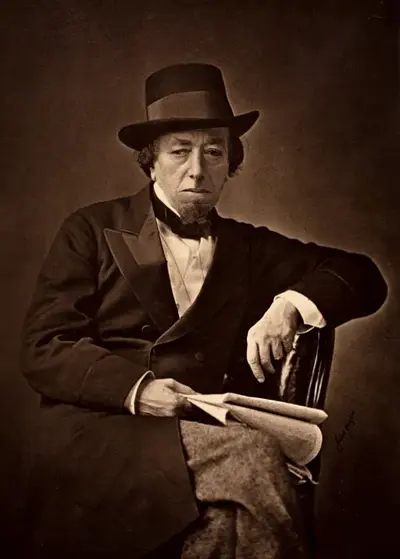
Benjamin Disraeli, 1st Earl of Beaconsfield, KG, PC, MP, FRS, was twice Prime Minister of the United Kingdom, serving in 1868 and from 1874 to 1880. He was a member of the British Conservative Party and played a central role in the creation of the modern Party, defining its policies and its broad outreach. Disraeli is remembered for his influential voice in world affairs, his political battles with the Liberal Party leader William Ewart Gladstone, and his one-nation conservatism or "Tory democracy". He made the Conservatives the party most identified with the glory and power of the British Empire. He is the only British prime minister to have been of Jewish birth. He was also a novelist, publishing works of fiction even as prime minister.
