Corrine Brown Quotes
Southern states in the confederacy were not ready to give up their fight to secede or give up their way of life, which was made possible in large part through the blood, sweat and tears of African slaves.
United States, Congress, House. Representative Brown speaking on Recognizing the Historical Significance of Juneteenth Independence Day. Congressional Record, Government Printing Office, 19 Jun. 2006, p. H4198.


He had been a politician and was serving in the Union Army. At the time he was an Army officer just returned from the front and was not yet president.

This quotation is very important for in the 20th century Southern revisionists made a major effort to ennoble the Confederate cause by claiming that Slavery and the desire to keep Blacks in bondage and unequal was just of byproduct of the reason for secession—States Rights and the decentralization of government. Many of the school history books were changed to reflect this claim. However, each of the seceding states left a legislative record of secession and the reasons for it. In all cases, Slavery and the preservation of Slavery in the South was the central and in most cases the only reason stated. In this case, Texas made its reasons clear. There was nothing noble therein but racism and racial exploitation.

Some Southerners, in order to obtain support in England for the Confederate cause claimed in their propaganda that slavery was not the issue but their issue with the Union was just one of local and regional autonomy. The British and most Europeans at that time were strongly against slavery so this “spin” might have gotten some support. Stowe and others put the lie to this, and the Confederacy never did get any significant material support from any country in Europe. The secession resolutions of the Southern States all state that Slavery was the cause (and often the ONLY cause stated) of secession. Also Southern General Mosby, called the spin for what it was. See {584991}.


This newspaper editorial has historical importance for two reasons. First, it is yet another proof that the sole reason for southern secession was slavery. Second, note the implication that Lincoln had Negro ancestry. As that could be the only reason that he would hold his views on slavery. This disreputable tactic of slandering opponents who hold different views have extended to German ancestry in WWI, Catholic religion, communist affiliation, and in one of the more recent examples, the accusation—believed by a number of Americans, that President Obama was a secret Muslim.


One of the puzzles of American Civil War history has been how the poor whites of the South (who provided most of the military manpower that fought and died in the Civil War) were persuaded to fight against a much stronger, more highly industrialized, and more affluent few, that had many more soldiers. One of the main reasons, though difficult for us to understand today, was that the Southern leadership actually persuaded the Southerners that men from the North were cowards and lacked the character, virtue or will to fight. The general “party line” of the South was that one Southern solder was worth more than 5 Northern Soldiers,

Much of the South was so insular that people knew nothing about the notion of abolition and just assumed that no one would ever consider freeing the slaves. Many never knew that it was the South that first fired on the Union troops and flag. If the North won the war, the assumption was that Northerners would then own the plantations and the valuable slaves. In reality, while all slaves were emancipated in the South, very few plantations and farms were confiscated from their Southern owners by Northerners despite the fact that there was political pressure in the North to confiscate the land of all rebels who had committed treason and use the value to repay the Union bonds and care for the wounded Union veterans and the widows of dead Union Soldiers. Eggleston was an accomplished writer who had served in the Confederate army of the Civil War. 20 year after the war he wrote a series of articles for the prestigious Northern Atlantic Monthly trying to convey the war from the Southerner’s point of view.

Marx followed the American Civil War very closely. The freeing of the slaves caused an immediate social, moral and economic revolution, the results of which we live with today.


The Georgia flag with the Confederate flag inset was adopted by the legislature in 1956 during the civil rights struggle. The Governor called for legislation bringing back the old flag.


After the Civil War and Reconstruction, the American nation was still bitterly divided intelelctually, socially, emotionally and poliotically. In an effort to bring more unity to America, most of the power stucture and the influentials of the nation began to avoid those issues that would divide North and South and try and promote a narrative that both sides might be able to live with. And this is what Zeitz describes in this quotation. America went through a period of Revisionist History that even in the 21st century was held by many people. It wasn't until the middle of the 20th century that the real history and narrative of the Civil War and Reconstrution emerged from the few academics who had all along criticized the fabricated narritive that did unify the country at the cost of historical accuracy and truth. Many scholars point out that the price that America paid for this unity was the Jim Crow era and a century of legalized racism. Much of the nation was built on the labor of Negro slaves and the victims of the slavery era, also bore the brunt of American unity and reconcilliation.
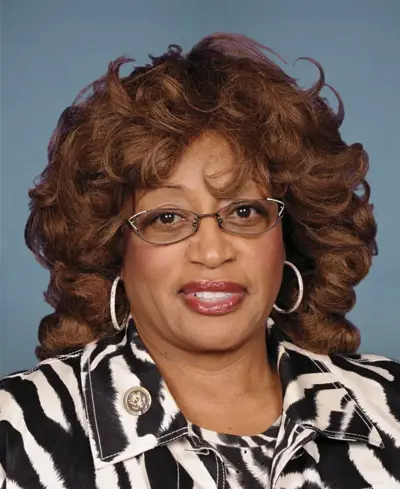
Corrine Brown is an American former politician and convicted felon, who served as a member of the U.S. House of Representatives from Florida from 1993 to 2017. She is a member of the Democratic Party. After a court-ordered redistricting significantly changed her district, and a federal indictment for corruption, Brown was defeated in the 2016 Democratic primary by Al Lawson, who went on to win Brown's former seat.
