Ali Khamenei Quotes
Should the Iranian nation beg for the right of exploitation of nuclear energy from the bullying world powers until they accept that the nation has a nuclear right?...No. This is not the way of a free and independent nation.
There was no problem with Iran having nuclear power. However, they wanted to utilize a process with which fuel for nuclear bombs could be made. Russia had offered to provide them with nuclear fuel for any power plant that they might want to create, but Iran refused insisting that they had a right to enrich their own uranium. Then they lied to the inspectors for the United Nations Atomic Energy Commission. They had threatened to “wipe Israel off the map” and the major Arab nations in the area secretly asked the United States to prevent Iran getting nuclear weapons even if force had to be used. Economic sanctions were tried first.
Ali Khamenei, Grand Ayatollah & Iranian Supreme Leader, June 2007
Sourced by: Eigen's Political and Historical Quotations


Many politicians and military thinkers disagree with Kraus. America, England, France, Russia, and Israel have all demonstrated over the years that even with great provocation they would not resort to nuclear retaliation nor have they ever threatened use of WMDs. Iran, in contrast, has repeatedly stated as one of their major objective, the total destruction of another UN member state—Israel. Further, Iran has never possessed a weapon that it did not use shortly after possession, including poison gas. Therefore America and the United Nations have all determined that a double standard is necessary with Iran.

The Prime Minister of Israel and his cabinet had claimed that the agreement negotiated by the US and other powers with Iran would not stop the Iranians from developing nuclear weapons. However, one of the most knowledgeable Israelis here stated the opposite over what the Israeli official position had been.

There had been so much nuclear activity—military and civilian—that he thought it inevitable, either by intention or accident, that there would be some catastrophes. Chernobyl and the crash of a nuclear bomb equipped plane in Spain destroyed the two areas for years thereafter proved him prescient but fortunately none of the “incidents” were bad enough to affect millions of people significantly although the damage of Chernobyl is still being discovered.


The Iranian religious theocrat of Iran sees the issue as one where the United States is trying to keep nuclear technology from Iran and other Islamic countries. He seems to discount his own often uttered calls for “death to America” and the statements of intended war with the United States by the leading military officer of Iran. See {624408}.


Sandia is a company that has gotten almost all their business from the Federal Government for doing research and development of nuclear weapons. Based on this view and others the AEC and the military not only developed small atomic bombs with short range rockets that could be transported in jeeps, but actually developed a 51 lb. atomic bomb that a soldier carried on his back. The idea was for these solders to parachute behind enemy lines, place the bomb near an important enemy facility and escape the critical zone on foot before the bomb exploded. It was never used in combat and receded in interest except for the fact that it proved it was possible for a terrorist suicide bomber on foot to place and explode a nuclear weapon.


The origin of the United States refusal to rule first use out lies with the Cold War concern of a massive Russian Ground attack in European countries. Even with NATO, we could not deploy ground and air resources fast enough to prevent the takeover of entire countries. Then when we amassed the troops and airpower to counterattack, there would be massive civilian casualties of the invaded nations. So American strategy, at the insistence of our European Allies was to deter invasion. By renouncing first use, the Western Powers would almost invite the Russians to invade European nations. There was a similar fear of North Korea and China,
This was his last publication. He died of a heart attack as the magazine was being printed. Since this was written one other possible use of nuclear weapons has been suggested—namely, retaliation for a biological attack. From a policy point of view, maintaining an arsenal of biological weapons for retaliatory purposes is dangerous and use for retaliation of biological weapons is not very controllable and arguably less humane than a nuclear weapon. His point however still holds. We have to have a national defense policy against many threats and we have to have defense policies that handle all these without nuclear tactics is insufficient to handle any of the threats without causing more problems and we have other weapons and techniques that are just as, if not more, effective. They and systems under development have the major role in our current defense policy.

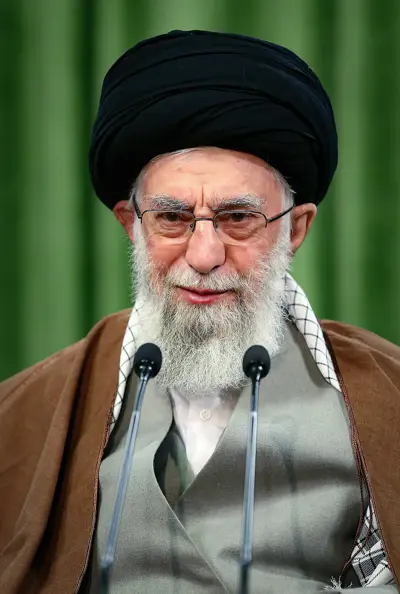
Sayyid Ali Hosseini Khamenei is a Twelver Shia Marja' and the second and current supreme leader of Iran, in office since 1989. He was previously President of Iran from 1981 to 1989. Khamenei is the longest serving head of state in the Middle East, as well as the second-longest serving Iranian leader of the last century, after Shah Mohammad Reza Pahlavi.
