John Quincy Adams Quotes
… she [America] goes not abroad, in search of monsters to destroy. She is the well-wisher to the freedom and independence of all. She is the champion and vindicator only of her own. She will commend the general cause by the countenance of her voice, and the benignant sympathy of her example. She well knows that by once enlisting under other banners than her own, were they even the banners of foreign independence, she would involve herself beyond the power of extrication
John Quincy Adams 1767-1848, 6th President of the United States (Independent, MA), Address to U.S. House of Representatives, July 4, 1821
Sourced by: Eigen's Political and Historical Quotations


Inscribed in the John Adams Building of the Library of Congress. On this subject Jefferson was in agreement with George Washington {37176} and his political opponent, John Adams {592705}.


The American sense of exceptionalism of the democratic republic we created and the almost messianic duty to extend freedom and democracy throughout the world is actually relatively new in American history. For most American existence, the sense of the desirability of spreading the American freedom was held from the very beginning, but it was very much inhibited by American isolationist tendencies and entanglements on other nation’s affairs.


The plan was to have an American agent with a few marines make an alliance with a rival to the throne of Algiers and depose the existing ruler with American “special forces”.


Chamberlain’s policy was to appease Hitler and Germany to avoid war. Although he did not see Czechoslavkia as a critical British national interest and claimed he had secured peace {585941} , the reality was that he gave Germany room to start its aggression which would engulf all of Europe and much of the world. The British became the only bulwark against Hitler until the Russians stopped the Germans and America entered the war.


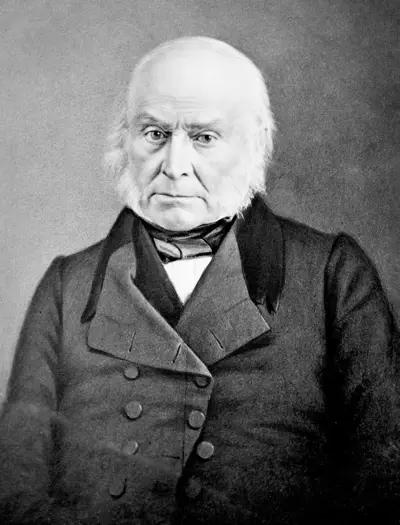
John Quincy Adams was an American statesman, diplomat, lawyer, and diarist who served as the sixth president of the United States, from 1825 to 1829. He previously served as the eighth United States Secretary of State from 1817 to 1825. During his long diplomatic and political career, Adams also served as an ambassador, and as a member of the United States Senate and House of Representatives representing Massachusetts. He was the eldest son of John Adams, who served as the second U.S. president from 1797 to 1801, and First Lady Abigail Adams. Initially a Federalist like his father, he won election to the presidency as a member of the Democratic-Republican Party, and in the mid-1830s became affiliated with the Whig Party.
