Vannevar Bush Quotes
… science may implement the ways in which man produces, stores, and consults the record of the race....
See {68645} for his vision of how this would be done.
Vannevar Bush, 1890-1974, Presidential Science Advisor, Director of Wartime Office of Scientific Research and Development, "As We May Think", The Atlantic Monthly, July 1945
Sourced by: Eigen's Political and Historical Quotations

What he called a “memex” is essentially what a PC, a tablet, or a smart phone would do in 2010. Bush was a great visionary and was appreciated by politicians as such. Bush had advised FDR to go ahead with the research and development program to try and develop an atomic bomb. He was the only Government Official who Roosevelt discussed the idea with. At the time, Bush as a government official supervised and directed many thousands of scientists, and was one of just a few scientists who monitored and advised on the Manhattan Project to develop the Bomb.


Computers, robots have replaced many more American workers than those who lost their jobs by having them replaced by foreign labor. Ironically, even in counties like China, South Korea, and a number of others, have "liost" millions of jobs to automation thenselves.


The collection of quotations, its cross references, concepts, and search engine is just the kind of thing that Bush was predicting.
This is one of the great perceptions of what was to come in computing.


He was one of the fathers of modern computer science and the first serious programmer. Before there were computers generally available, he had programmed special IBM machines to crack the German’s “uncrackable” Enigma code.


He was one of the team that created the first Atomic Bomb. In 1946, the atomic bomb was known about by almost all Americans and almost no one had even heard of a computer or the concept of a computer. The British and Americans during the war had collaborated to build very limited electronic calculating machines but the concept of programs to control the calculating machines was new—initially created by van Neumann and Englishman Alan Turing. When he made this statement most people thought it was the ravings of a “mad scientist. He was one of the team that later developed the first real computer at the Institute for Advanced Study at Princeton.”

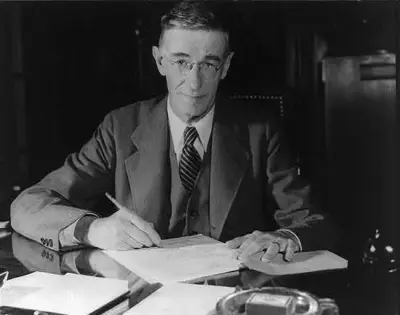
Vannevar Bush was an American engineer, inventor and science administrator, who during World War II headed the U.S. Office of Scientific Research and Development (OSRD), through which almost all wartime military R&D was carried out, including important developments in radar and the initiation and early administration of the Manhattan Project. He emphasized the importance of scientific research to national security and economic well-being, and was chiefly responsible for the movement that led to the creation of the National Science Foundation.
