William Westmoreland Quotes
President Johnson did not want the Vietnam War to broaden. He wanted the North Vietnamese to leave their brothers in the South alone.
Westmoreland, William C. Interview. Academy of Achievement, 22 Jun. 1996.


The occasion was the visit to Washington of French Minister M. Jean Letourneau. The French were fighting the communists in Vietnam and the U. S., not yet in the fight, promised material and political aid, but no military participation. It was almost a decade later that America sent its first military personnel to Vietnam. The West was persuaded that the French could handle the situation. When they were defeated, America and Britain assumed that it was the notorious military incompetence of the French that accounted for the situation rather than the competence and commitment of the Vietnamese Communists and their support of the majority of the people.


Later, when he ran for the Democratic Presidential Nomination had had changed his mind and was a major opponent of the Vietnam War. This was the pattern of so many Americans whose first instinct was to support the government’s decision to wage war, and over time grew disenchanted with the war and ended up opposing the war actively.


Boggs was working on some compromise positions that could be taken by the party at the 1968 Democratic National Convention to provide the anti war wing of the party with something. The President found out and met with Congressman Boggs.


Up to that time U. S. policy was to provide training and assistance to the South Vietnamese government and military, but not to attack the North. America had backed a corrupt and incompetent South Vietnamese government and Bundy and other policy makers were convinced that the North Vietnam would win, if the fighting and governing were solely left to the South Vietnamese. Johnson, who had resisted this policy for several weeks finally acceded. It was a major escalation of the Vietnam War.


War and international conflict had become very complicated in modern times. Americans and most other people associated victory in war with unconditional surrender. However, since the unconditional surrender is of WWII, no conflict has ended with an unconditional surrender.


Trieste was occupied by the British and Americans theoretically, but Tito’s Yugoslavian troops had done most of the WWII fighting and dying in the area and wanted control for the Russian Allies of which Tito was then one. There were frequent armed standoff’s of Anglo Americans and Yugoslav troops that could easily have evolved to full scale fighting. Nine months later, Tito broke with Stalin. An interesting historical fact is that Richard M. Nixon was one of the Congressional Delegation then visiting Trieste.

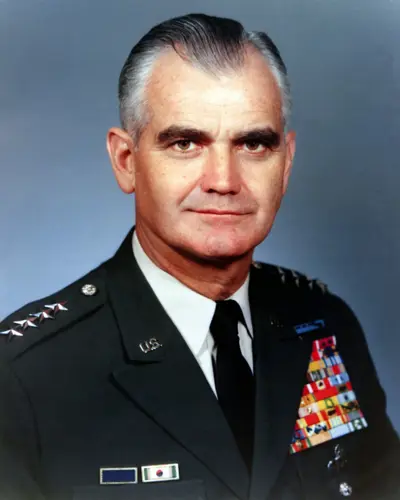
William Childs Westmoreland was a United States Army general, most notably commander of United States forces during the Vietnam War from 1964 to 1968. He served as Chief of Staff of the United States Army from 1968 to 1972.
