John C. Calhoun Quotes
Peace is, indeed, our policy. A kind Providence has cast our lot on a portion of the globe sufficiently vast to satisfy the most grasping ambition, and abounding in resources beyond all others, which only require to be fully developed to make us the greatest and most prosperous people on earth.
Calhoun, John C. "Speech on the Oregon Question." The Works of John C. Calhoun, edited by Richard K. Crallé, vol. 4, D. Appleton and Company, 1854, p. 272.


The irony was that it was by warfare that he conquered most of the Hawaiian Islands and formed them into a kingdom.


Many of the French Revolutionists viewed the French Revolution as only the first step in a European revolution where all monarchies in Europe would be overthrown and popular rule installed throughout the continent. See Warville {585774} for an example. This obviously made the crowned heads of Europe and their governments very nervous. Other French Revolutionaries like Robespierre, however, wanted to assure the rest of Europe that the revolution was only a French affair so that they should not send troops to overthrow the French Revolution.


The statement he coined was one of the most common slogans in the 1960s. It was on signs, bumper stickers, T-shirts—even tattoos on people’s bodies. It is still a favorite of peace advocates.


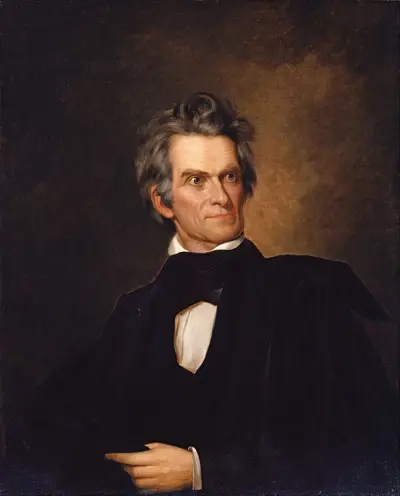
John Caldwell Calhoun was an American politician and political theorist from South Carolina who held many important positions including being the seventh vice president of the United States from 1825 to 1832, while adamantly defending slavery and protecting the interests of the white South when its residents were outnumbered by Northerners. He began his political career as a nationalist, modernizer, and proponent of a strong national government and protective tariffs. In the late 1820s, his views changed radically, and he became a leading proponent of states' rights, limited government, nullification, and opposition to high tariffs. He saw Northern acceptance of those policies as a condition of the South remaining in the Union. His beliefs and warnings heavily influenced the South's secession from the Union in 1860–1861.
