Qianlong Emperor Quotes
Our celestial empire possesses all things in prolific abundance and lacks no products within its own borders. There is therefore no need to import the manufactures of outside barbarians.
Ch'ien-lung, 1711-1799, Emperor of China, Letter to King George III of England
Sourced by: Eigen's Political and Historical Quotations


The Country was still in the Depression.

This same argument was used before and since to justify protecting domestic manufacturing from foreign competition until it can mature sufficiently to compete in a global economy. One difficulty occurs if protective tariffs are imposed for this reason. The manufacturers protected never seem to reach the point where they can compete without the subsidy.


The Chinese authorities wanted to stop the distribution and use of opium, but the British merchants, in one of the more disgraceful episodes of British history, would not stop the trade and actually went to war when the Chinese tried to stop the opium trade. See {625957} for more on this incident and the First Opium War that followed.

The “foreign tribes” were the English and other European traders who were bringing opium to China. Lin had assembled a fleet of 80 ships at the mouth of the Pearl River to persuade the European powers that they would fight if the foreign ships would not cease trading in opium. The British in particular were not intimidated, and they militarily forced the Chinese to accept their “right” to sell opium. The Emperor sent Lin to the “boondocks”—see {621320} for misjudging and provoking British military action, but Lin is remembered for his sound moral and public health perspective. A bronze statue of Lin Zexu was erected in his honor in Chatham Square (Kimlau Square) of New York City's Chinatown and many other places in the world.
A bronze statue of Lin Zexu was erected in his honor in Chatham Square (Kimlau Square) of New York City's Chinatown.

A self-contained market would be one in which a country only makes products that it sells within its borders, and only sells products that in makes in the country. Very primitive cultures were self-contained markets, but trading generally takes place whenever two cultures interact unless politicians artificially prevent it.


The British Government was planning to have a referendum on changes that might be negotiated in the laws of the European union vis a vis the member nations.

This historical quotation shows us that the nation under Republican control at the end of the 19th century was highly protectionist. In addition. It shows us how a party can flip flop on its most cherished principles. A century later, free trade was the cornerstone of Republican philosophy and opponents who held to the Republican 19th century principles were accused of being detriments to the American growth and economic system.


5th Earl of Rosebery


She was ruling the largest country in the world and Denby’s opinion was held by most who knew China. What made her all the more remarkable was that, as a Chinese lower middle class women, she had no formal education, had rarely been allowed to travel out of her home or interact with men. As a young teen she was made a concubine to the Emperor and rarely left the harem. Like Abraham Lincoln she was self-taught and not only was able to seize power in China without any male advisor or patron, but she ruled as well as any world leader. In her later years she was pushing her country too fast and far, and the Western Powers had caused much domestic difficulty and to maintain power, she had to ally with the anti-West Boxers causing her reputation amongst Westerners to sink dramatically and thereafter was never much acknowledged for her remarkable political skills and accomplishments.

This was in response to English Emissaries who wanted to establish trading businesses in China. The Emperor would not even meet personally with Lord McCartney, the first British envoy because McCartney would not kow-tow to the Emperor. The “hongs” were special businesses set up by Chinese businessmen who had paid the Proper fee, for the purposes of being traders with foreigners. Canton, now Guangzhou, is 150 years later still the major international trading center in China although there are no longer restrictions. At the time, the British paid for their Chinese good with Opium that they had purchased in their Indian Colony. English cloth and other goods would be sent to India, traded for opium, which was brought to China and traded for tea, silks and porcelain which were returned to England and turned into cash than was worth much more than their original purchase and the cost of the voyage.
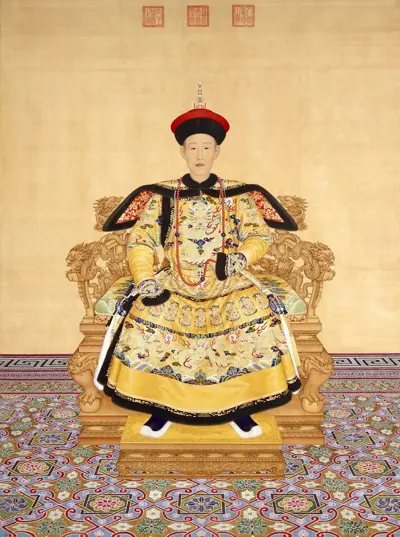
The Qianlong Emperor was the fifth Emperor of the Qing dynasty, and the fourth Qing emperor to rule over China proper, reigned from 1735 to 1796. Born Hongli, the fourth son of the Yongzheng Emperor, he reigned officially from 11 October 1735 to 8 February 1796. In 1796, he abdicated in favour of his son, the Jiaqing Emperor—a filial act in order not to reign longer than his grandfather, the Kangxi Emperor, who ruled for 61 years. Despite his retirement, however, he retained ultimate power as the Retired Emperor until his death in 1799. He thus was one of the longest-reigning rulers in the history of the world, and dying at the age of 87, one of the longest-lived. As a capable and cultured ruler inheriting a thriving empire, during his long reign the Qing Empire reached its most splendid and prosperous era, boasting a large population and economy. As a military leader, he led military campaigns expanding the dynastic territory to the largest extent by conquering and sometimes destroying Central Asian kingdoms.
