Todd S. Purdum Quotes
Nobody is afraid of him, and that’s not a good place to be for a president.
Obama was a President who believed deeply in the concepts of checks and balances and separation of powers. He did not punish members of Congress who opposed him by closing federal installations in their state of district, not giving government contracts to companies in his district and in the case of member of his own party who were “recalcitrant” supporting opponent in primary elections and failing to support in general elections. Presidents Nixon and Johnson used these techniques particularly effectively. As a result they pushed their legislative programs through Congress very effectively. All other modern Presidents have done this to one degree or another, but Obama did not. He believed that pressure on member of Congress should be limited to persuasion and public debate moving public opinion. Many seasoned politicians and political observers however thought that this was Obama’s biggest weakness as a President. Lyndon Johnson did not have to actually punish many member of Congress, as his willingness to do so was well known and thus few opposed him when he called or met with them and “gave them the treatment.” But Congress knew that Obama had taken punishment and retaliation off the table, and many opposed him including member of his own party.
Todd S. Purdum, Journalist, Assessing Barack Obama as a President, PBS The Charlie Rose Show, September 18, 2013
Sourced by: Eigen's Political and Historical Quotations


In 1995 the president had agreed with our allies to send troops to support a peace in Bosnia if there was one, but many in Congress attempted to block that possibility.

Alberto Gonzalez, White House Counsel and later Attorney General who was forced to resign and David S. Addington, Counsel to the Vice President, had come up with a novel view of the powers of the presidency. They argued that since the President is the Commander in Chief, in a war situation or intelligence gathering thereto, has the Constitutional responsibility for that function, he need not obey any laws of Congress as in the conduct of the war Congress would be impinging on the Constitutional separation of powers which itself was prohibited by the Constitution. The argument did not find any significant legal support but for a while the George W. Bush White House behaved as if this were the law, despite the fact that even in the American Revolution and the War of 1812 Congress passed laws regulating the conduct of the armed forces as is provided for in other parts of the Constitution. Yet even Goldsmith would allow the President some powers that many think are unconstitutional and/or belong to Congress. See {32436}.


His role was the equivalent of the Mayor of Washington DC. Even though the Congress had generally been the most powerful branch of the government, public opinion on this was beginning to shift at the turn of the 20th century.


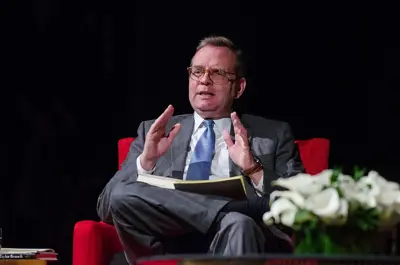
Todd Stanley Purdum is a national editor and political correspondent for Vanity Fair.
