Anthony Kennedy Quotes
No one questions the validity, the urgency, the essentiality of the Voting Rights Act.
Kennedy, Anthony. Transcript of Oral Argument, Northwest Austin Municipal Utility District No. 1 v. Holder. 557 U.S. 193, Supreme Court of the United States, 29 Apr. 2009.


The voting problems we have had are managerially and technology solvable but politically each solution is perceived as favoring one of the political parties in the particular jurisdiction and therefore there is resistance to the change.


At the time less than 10% of the Southern Blacks were allowed to vote. The result was that Southern segregationists were elected to Congress even in a state like Mississippi which had a majority Black population, The Southern segregationist bloc was large enough that with a few very conservative Republicans, they formed a coalition could block any civil rights legislation including voting rights reform,
Ironically, for 100 years after the Civil War, it was the Democrats who tried to keep the Blacks from voting as until Franklin and Eleanor Roosevelt began to attract Negro votes, Blacks voted overwhelmingly Republican. In 1964 President Johnson, with bipartisan support overcame the Southern Democratic Filibuster and passed the Civil Rights Act and then the Voting Rights Act. The Republican leadership, sensing the Southern Democratic Anger at the Democratic Party Leadership, implemented their Southern Strategy and embraced the most racist Southern Democrats if they would switch parties. Most did quickly. Soon, almost all the conservatives had abandoned the Democratic Party. This made the Republican Party more conservative and soon liberal Republicans were extinct and by the end or the 20th century, most of the moderates were gone. With almost all of the worst racists in the nation becoming Republicans and being warmly welcomed by the Republican leadership, almost all Blacks became Democratic voters. Then the racist conservatives went back to their time-tested mechanisms for suppressing the Black vote—only this time it was for the benefit of the Republican party. Soon the non-racist Republicans, realizing that minority voter suppression could be an effective mechanism to offset the greater minority fertility rate, the increased voting rate of the young, and the alienation of many unmarried women to the more conservative Republican ideology, got behind voter fraud prevention—a more acceptable purpose for activities that coincidently could make it more difficult for minorities to register and vote. Those activities were what Judge Debevoise was referring to in this quotation.

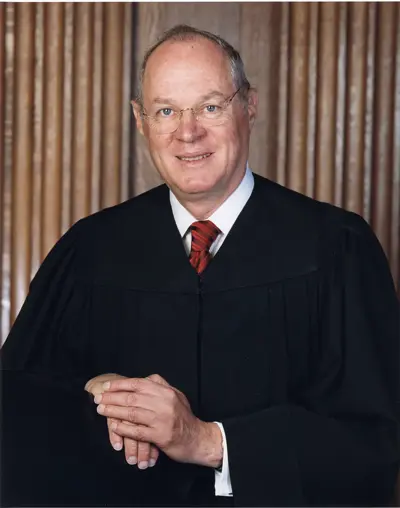
Anthony McLeod Kennedy is a retired American lawyer and jurist who served as an Associate Justice of the Supreme Court of the United States from 1988 until his retirement in 2018. He was nominated to the court in 1987 by President Ronald Reagan, and sworn in on February 18, 1988. After the retirement of Sandra Day O'Connor in 2006, he was the swing vote on many of the Roberts Court's 5–4 decisions.
