Vermont Quotes
no male person, born in this country, or brought from over sea, ought to beholden by law to serve any person, as a servant, slave, or apprentice, after he arrives to the age of twenty one Years; nor female, in like manner, after she arrives to the age of eighteen years; unless they are bound by their own consent after they arrive to such age; or bound by law for the payment of debts, damages, fines, costs, or the like.
Vermont, Constitution, July 4, 1786
Sourced by: Eigen's Political and Historical Quotations

In the first article of its first Constitution Vermont banned slavery and indentured servitude. Delaware had previously done it. See {621427}


Manava Dharma Shastra. This text is a part of the Hindu Holy Texts. Hindus believe that Manu was a prophet whose text is revealed or inspired.


This was a compromise. Most Mexicans wanted immediate emancipation of all slaves. However, Stephen Austin and others desirous of attracting colonists thought that this would inhibit too many American Southerners from immigrating to Texas. Slave enthusiasts wanted no prohibition on slavery. The Mexican Emperor issued this compromise but was soon thereafter overthrown. The law was then repealed by the revolutionary government and emancipation was immediate. However, Austin was able to persuade the junta to keep the law in place for Texas only, and so it was. A similar law was being debated by Congress but the Southerners were able to block it. There were still slaves and slavery in Texas. Four years later {613642} there were more restrictions on slavery.


This law required the treatment of Blacks as whites were then treated with respect to indentured servitude—a limit of 10 years after which the person would be free. However, this law was poorly enforced. The “General Court” was the name for the legislature of the Rhode Island colony.


This was one of the first opportunities that Congress had to legislate on the slavery issue. The Southerners were adamantly opposed to this article although by previous agreement the issue of slavery in the original 13 states could not be interfered with. Majority sentiment of the nation at the time was opposed to extending slavery into the territories. The second part of the quotation shows however, that the slavery in the Southern States would not be undermined by allowing fugitive slaves to escape into the territories, so there was a compromise of sorts that pushed the inevitable clash over slavery off. Compromise and struggle ensued for 70 years until it finally erupted as the Civil War.


This concept was one of the main selling points that the Southern leadership used to invest poor whites in the Confederate cause. The poor white, no matter how bad off he’s was, cold always see himself above the Negroes who were fit for being a servant while he was above that.

This law was passed soon after the when South Carolina was controlled by abolitionist recinstructionists. Most blacks were trained for little else but being field hands or house servants. This was one example of several attempts to remedy that situation. Here the concept of indentured servitude was used as that had been a traditional method of an apprentice trading his labor for the opportunity to be educated and trained. It was not long before the racists again gained control of the legislature and via the Black Codes turned this program (like so many others) into variations of chattel slavery without legal ownership. Note that parental consent was required and that both Negroes and Whites could have apprentices. There were a few newly freed slaves that had developed skills and had a trade who took apprentices and some free Blacks from the North went South to start businesses, but soon were obstructed by the old Southern establishment.
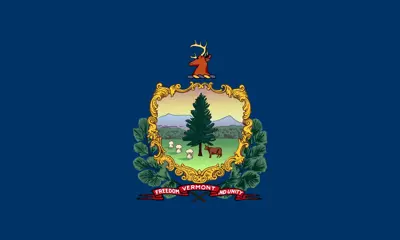
Vermont (/vərˈmɒnt/ (listen)) is a state in the New England region of the United States. It borders the states of Massachusetts to the south, New Hampshire to the east, and New York to the west, and the Canadian province of Quebec to the north. Vermont is the only state in New England that does not border the Atlantic Ocean. Vermont is the second-least-populated U.S. state and the sixth-smallest by area of the 50 U.S. states. The state capital is Montpelier, the least-populous state capital in the United States. The most-populous city, Burlington, is the least-populous city to be the most-populous city in a state.
