Curtis LeMay Quotes
Native annalists may look sadly back from the future on that period when we had the atomic bomb and the Russians didn't. Or when the Russians had aquired (through connivance and treachery of Westerns with warped minds) the atomic bomb - and yet still didn't have any stockpile of the weapons. That was the era when we might have destroyed Russia completely and not even skinned our elbows doing it.


This prediction was sadly terribly accurate. Nuclear terrorism is a realistic threat at the millennium. Pannekoek was one of the first to predict it.


This was the first Russian atomic explosion.


This statement was made at the height of the Cuban Missile Crisis.


This quotation is very important in helping to understand the 1950s in America with respect to nuclear weapons policy. McCormick was one the better educated, sophisticated, and influential Americans. Yet he appears to be a technological and nuclear ignoramous. Most people had not yet realized that atomic weapons were not just much larger traditional bombs. They could do terrible damage, but it would always be localized they thought. Chicago might be destroyed but the people out of range would be OK. He never got it that a dirty bomb could be dropped on Detroit and depending on which way the wind is blowing could wipe out Chicago and much of the Midwest as well. He knew nothing of the genetic effect the radiation, nor the implications for the environment of maintaining a large nuclear manufacturing industry. He and many like him did not realize that after the first bombs were created, how easy it would be for the Russians and others to also develop a nuclear arsenal. And 50,000 warheads was just a matter of effort. The implications of these things would inhibit our carrying out his and others ideological views of foreign policy. Oppenheimer and most nuclear scientists explained all this, but believing them and acting on those beliefs would have been too much of a change.


Only three days later the Russians detonated their first atomic device.


3 days later, President Truman, announced that the Russians had successfully developed an atomic weapon. This quotation gives us another example where the Central Intelligence Agency failed to predict and/or warn America about a crucial event. Others included the North Korean invasion of South Korea, the Arab Spring, the Soviet invasion of Afghanistan, the fall of the Berlin wall, and the collapse of the Soviet Union.
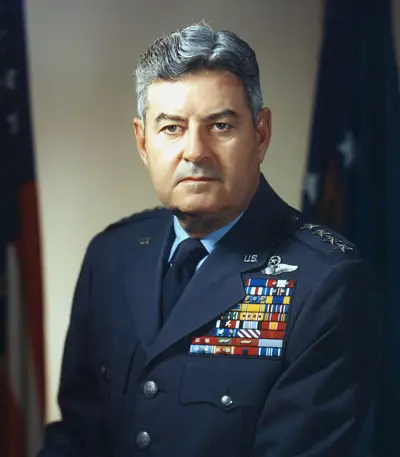
LeMay became a pursuit pilot and, while stationed in Hawaii, became one of the first members of the Air Corps to receive specialized training in aerial navigation. In August 1937, as navigator under pilot and commander Caleb V. Haynes on a Boeing B-17 Flying Fortress, he helped locate the battleship Utah despite being given the wrong coordinates by Navy personnel, in exercises held in misty conditions off California, after which the group of B-17s bombed it with water bombs. For Haynes again, in May 1938 he navigated three B-17s 620 nm (610 miles or 980 km) over the Atlantic Ocean to intercept the Italian liner SS Rex to illustrate the ability of land-based airpower to defend the American coasts. In 1940 he was navigator for Haynes on the prototype Boeing XB-15 heavy bomber, flying a survey from Panama over the Galapagos islands. War brought rapid promotion and increased responsibility.
