John Cheever Quotes
My God, the suburbs! They encircled the city's boundaries like enemy territory and we thought of them as a loss of privacy, a cesspool of conformity and a life of indescribable dreariness in some split-level village where the place name appeared in the New York Times only when some bored housewife blew off her head with a shotgun.
Cheever, John. The Journals of John Cheever. Knopf, 1991.


Moses became the greatest “builder” the world had ever known. The Bridges and tunnels into New York, the highways in the city and Long Island, the development of Fire Island and the World Trade Center were all his work. Babbitt was a very large building and construction contractor. The Cold War was ongoing and his reference to civilian defense was an absurd notion of the 1950s that building bomb shelters in cities and homes could protect the civilian population in the event of nuclear attack. This was actually an official government position and program.


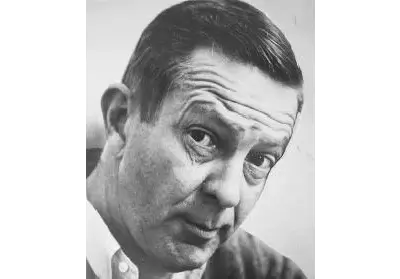
John William Cheever was an American novelist and short story writer. He is sometimes called "the Chekhov of the suburbs". His fiction is mostly set in the Upper East Side of Manhattan, the Westchester suburbs, old New England villages based on various South Shore towns around Quincy, Massachusetts, where he was born, and Italy, especially Rome. His short stories included "The Enormous Radio", "Goodbye, My Brother", "The Five-Forty-Eight", "The Country Husband", and "The Swimmer", and he also wrote five novels, comprising The Wapshot Chronicle (National Book Award, 1958), The Wapshot Scandal (William Dean Howells Medal, 1965), Bullet Park (1969), Falconer (1977) and a novella Oh What a Paradise It Seems (1982).
