Sayyid Ahmad Khan Quotes
Muslims are bound to know all the tenets of their religion, to discuss them and to regulate their lives accordingly. Therefore, a purely secular education without religious instructions would be like a body without soul.
Sayyid Ahmad Khan, 1817-1898, Indian Islamic Modernist & Reformer, Quoted in Achmad Jainuri, The Reformation of Muslim Education: A Study of The Aligarh and The Muhammadiyah Educational System
Sourced by: Eigen's Political and Historical Quotations


Liberal has a somewhat different meaning in English politics than the word as used in America. In England, the opponents of conservatives are of the Labour Party. The Liberals are a third party who on some issues are liberal in American terms and on others, conservative. However, they are very tolerant and somewhat intellectual.


This sura is used by moderate Muslims showing that The Prophet was somewhat tolerant of those who even mock the word of Allah. Nonetheless, most fundamentalist Muslims believe that anyone who mocks the word of Allah or His Prophet should be killed. Muhammad said not to sit with them—his modern followers too often call it heresy and want to kill them.

Legal Religious Ruling. This is an example of a source of tension between some Muslims and others. Non-Muslims are required to have a Muslim Education in Muslim countries, but they insist that any required Christian or secular education in a non Muslim country is anti-Islamic.

See {586269} for an American view of the subject.


This quotation is fascinating but sad. In 1902, Aga Kahn III and other Muslim reformers gathered to improve the terrible state of Muslim education. Muslims could attend the English operated public schools which were excellent, but the Imams fought these schools as they were purely secular and not under their control. Yet the Madrassas religious schools that then existed taught by rote and only Islamic religious content—no mathematics, science, other literature, art or anything else. Much of the teaching was religiously extreme with not even modern religious content. Over a century later the Schools of Pakistan—the Islamic nation carved out of India and those of most of the Arab nations are little better and despite a century of progress, the curriculum is the same.


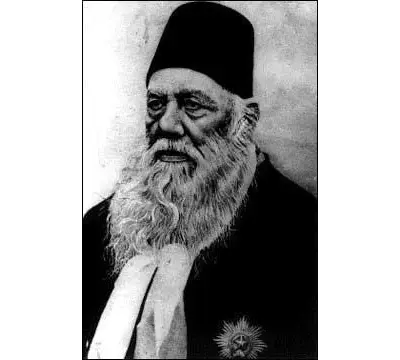
Sir Syed Ahmad Taqvi bin Syed Muhammad Muttaqi KCSI, commonly known as Sir Syed Ahmad Khan (also Sayyid Ahmad Khan), was an Islamic pragmatist, Islamic reformer, philosopher, and educationist in nineteenth-century British India. Though initially espousing Hindu-Muslim unity, he became the pioneer of Muslim nationalism in India and is widely credited as the father of Two-Nation Theory which formed the basis of Pakistan movement. Born into a family with strong debts to the Mughal court, Ahmad studied the Quran and Sciences within the court. He was awarded an honorary LLD from the University of Edinburgh in 1889.
