Recep Tayyip Erdogan Quotes
Minarets are our bayonets, domes our helmets and mosques our barracks.
He did not originate this line. It came from a Turkish religious poet. As a young politician, He was advocating a Muslim government. But Turkey is the only majority Muslim country whose Constitution requires a secular government as a result of the great revolution and reform of Kamal Ataturk who also ended the Caliphate. Erdogan was jailed for 90 days for attacking the secular government and urging a religious replacement. When he served his sentence he stayed away form demagogic and religious appeals to return the state to a theocracy. though some have always suspected him of having that motive.
Recep Tayyip Erdogan, Prime Minister of Turkey (Welfare Party), Mayor of Istanbul, Turkey (Welfare Party), Speech explaining the relationship between the Muslim religion and the Welfare Party in an otherwise secular state, Siirt, 1997
Sourced by: Eigen's Political and Historical Quotations

This quotation illustrated the extreme polarization between the current fundamentalist Muslims, and the Muslim modernists and the West. Kamal Ataturk, the great leader and stateman who is the father of modern Turkey, is castigated by the author for leading the new Turkish parliament to depose the Caliph – the civil and religious autocrat, one of whom reigned from after the death of Muhammad till his abolishment in 1924. Most of the rest of the world credits Ataturk with being one of the great leaders of all time—one who led a democratic revolution which transformed Turkey into the only Muslim secular democracy, requiring pubic secular European type education for all children, giving women the right to vote (before the U. S. even), adopting a European alphabet and dress, and outlook on life—creating most remarkably a total cultural revolution with virtually no loss of life. No revolutionary leader, before or since has led so extensive a political and cultural revolution, and it was a bloodless revolution. Turkey, into the 21st century, was by far the most powerful, industrialized, scientific and modern nation of Muslims in the world and others were far behind. Yet many Islamic theologian still castigate Atatork for his great achievements as being against the will of God.

While the vast majority of Muslims had little or no thought of Islam ruling or even dominating the non-Muslim part of the world. But of the minority of the Islamic Religious Extremists, most saw a struggle with the Christians, Jews, and other religions of the world until Islam ruled the world—an outcome which most saw as inevitable.


Turkey under its great leader, Ataturk, underwent a major cultural revolution. Although Turkey is overwhelmingly Muslim, its constitution provides that it be a secular state with compulsory public non-sectarian education. They adopted a European style law and prohibited Sharia (Islamic law). The nation thrived as no other Muslim country has. Muslims, the world over, are divided on Turkey. For this Sheikh its secular government is an insult to Islam because there is complete separation of mosque and state. For others it is the model which all Muslim countries should emulate.

Joseph ben Matthias. The term was coined by Josephus to refer to the fundamentalist, orthodox Jewish view of a proper state, as opposed to a secular government. The Jewish fundamentalist dream of a theocracy came down through modern times. There were ultra-orthodox Jewish groups who opposed the creation of the State of Israel on the grounds that it is not a theocracy and there are some who still want to see Israel transformed. The term became generalized and is applied to any state where the religion is the state and religious leaders dominate and control the state. The ultra orthodox Muslims, as in Iran, are generally the only religious group who have created theocracies or semi-theocracies as Islamic states. See {638106} for the context in which the term was first used.

The notion that Islam would be practiced by individuals was in the Ayatollah’s view insufficient. Islam must also control the government—the head.


Bangladesh had fared very poorly as a part of Pakistan. When it revolted and became independent, it adopted a secular government whereas Pakistan had been, and is, a heavily Islamic state. However, the vast majority of Bengalis were Muslim and some were extreme fundamentalists. Rahman was under constant pressure to make the government more “Islamic” and while he did so somewhat, he tried to advocate for separation of church and state. Bangladesh is not as extreme as Pakistan which is not yet a theocracy but religious forces dominate every aspect of the society.
This is the philosophical root of Islamic Fundamentalist terrorism. If this principle is accepted, then it is very easy to rationalize anything to change a situation where Islam and Islamic law does not control anywhere

Historically, this quotation shows that the negative relationship between the West and Islam and negative views of Islam was not a new phenomenon at the beginning of the 21st century. It existed long before, and as with the 21st century concerns, violence and war were the major concerns.
While the author represents the views of most Islamic Fundamentalists, a similar view is held by many ulta-orthodox Jews and fundamentalist Christians also.

Ahmad denied saying this although the reporter who wrote the original story insists that he did and she wrote it down at the time. Ahmad did not deny the statement when it first appeared in the Fremont Argus, but only did so several years later.

Gabriel exaggerates in the sense that while the quotation is correct for many Muslims, it is by no means true of all. Iran for example is an Islamic theocracy, but Turkey is a 99 percent Muslim nation which is totally secular and in some ways is much more restrictive of Islamic teaching and practice than most secular democracies. The fundamentalist Muslim view of the state and religion is essentially the same as the ultra orthodox Jews and Christians. It is true that a greater proportion of Muslims believe in the merging of civil and religious law than Jews and Christians, but by no means all. The non Arab Muslims are much less likely to see the unity of state and religion.

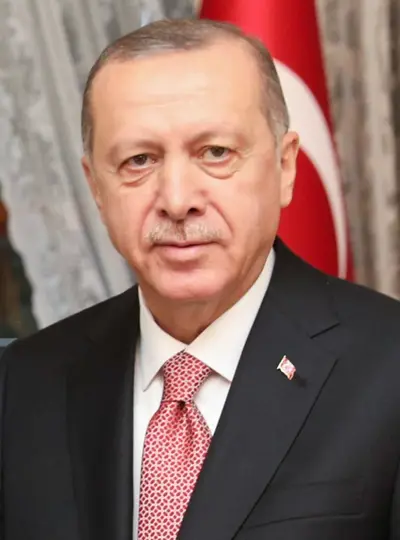
Recep Tayyip Erdoğan is a Turkish politician serving as the current President of Turkey. He previously served as Prime Minister of Turkey from 2003 to 2014 and as Mayor of Istanbul from 1994 to 1998. He founded the Justice and Development Party (AKP) in 2001, leading it to election victories in 2002, 2007, and 2011 before being required to stand down upon his election as President in 2014. He later returned to the AKP leadership in 2017 following the constitutional referendum that year. Coming from an Islamist political background and self-describing as a conservative democrat, he has promoted socially conservative and populist policies during his administration.
