Fyodor Dostoevsky Quotes
Men do not accept their prophets and slay them, but they love their martyrs and worship those whom they have tortured to death.
Dostoevsky, Fyodor. The Brothers Karamazov. Translated by Richard Pevear and Larissa Volokhonsky, Farrar, Straus and Giroux, 1990, p. 306.


It was a custom for suicide bombers in the Middle East to write or video record last words to loved ones.


The Bull was directed at French King Louis VII. On Christmas Eve the year before Zengi had broken into the city of Edessa and massacred the French inhabitants. This was the Proclamation of the start of the 2nd Crusade. Note that the Pope, in order to raise troops and money for the Crusades, used the remission of previous sins to motivate Pietro dei Paganelli di Montemagno

See {586041} for a Koranic quotation that urges world domination by Islam. In this quotation, The Prophet was talking to his followers at a time when Islam was not even a dominant religion in Arabia. And war was the way in which tribes, groups, and religions and sects, established themselves and grew. Although there are other Koranic passages which tell the faithful that people can only legitimately come to Islam through individual commitment and willingly, this passage not only seems to contradict that but also reflects a desire to punish and disgrace “non-believing” groups. This vengeance motif is also contradictory to much else of the Koran which generally preaches love, forgiveness, and understanding. However, there are contradictions and intellectual inconsistencies within the Koran just as there are within the Old and New Testaments.


In the midst of the Battle of Sevastopol in the Crimean War, Tolstoy was actually a young lieutenant. At a point in the battle a truce was called between the French and the Russians so that they could each collect their dead and wounded. Then the fighting resumed.
Gordon himself was killed shortly thereafter by the Madhi’s followers at the siege of Khartoum. Ahmed died soon thereafter. Although Ahmed was an extreme religious fanatic, and a skillful leader, he was not a terrorist.


At one level, this statement is typical of Christian theology and practice. Historically, the Christian martyrs were not only presumed to have gone to heaven but many of them were made Saints for their martyrdom. They assumed a type of equivalency of Christian prophets. The problem lies in the different concept of martyrdom. The martyrs of the Christian Church were almost all peaceful and docile people who would not repudiate their Christian faith even though tortured and killed. Martyrs in Islamic tradition included the above but more often were fighters and warriors who died on the battlefield or on a military mission of violence. In that sense, the modern suicide bomber is described as, and perceives him or herself as a martyrs. In Islamic culture, anyone who dies defending the faith, is a martyr. That person immediately goes to Paradise, bypassing all the other potential exclusions that the religion reserves for all others. Further, there are quasi religious beliefs about martyrdom in Islamic nations. One is that the martyr who acends to Paradise is given a bevy of virgins for his sexual pleasure for all eternity. This particular sura is used by suicide bomber recruiters to provide the highest level of religious authority to back up their claims of the advantages of a martyrs death to the would-be suicide bomber. Few of the recruiters however are sufficiently convinced of the martyrdom they sell so well, that they would willingly become martyrs themselves. While many Westerners see this as evidence of a major perversion of a perverse religion, they are usually unaware that in the Crusades, the Pope provided the same immediate ascension to Heaven for any Christian who died while fighting on the Crusades, and this was one of the major recruiting pitches to obtain volunteers to go to the Holy Land.
This is the type of person who suicide bomber recruiters seek out.

The Muslim Brotherhood Government had just been deposed by a popular coup d’etat carried out by the Egyptian military. The Brotherhood flooded into the streets to protest the coup and some of them attacked police with weapons. The military overreacted and in an effort to clear the demonstrators from the streets killed hundreds of them. This brought out signs like this.
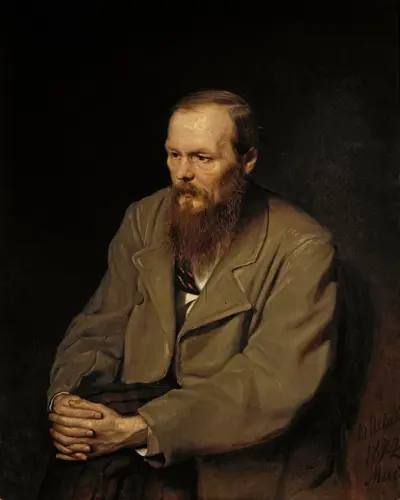
Fyodor Mikhailovich Dostoevsky, sometimes transliterated as Dostoyevsky, was a Russian novelist, philosopher, short story writer, essayist, and journalist. Dostoevsky's literary works explore human psychology in the troubled political, social, and spiritual atmospheres of 19th-century Russia, and engage with a variety of philosophical and religious themes. His most acclaimed works include Crime and Punishment (1866), The Idiot (1869), Demons (1872), and The Brothers Karamazov (1880). Dostoevsky's body of works consists of 12 novels, four novellas, 16 short stories, and numerous other works. Many literary critics rate him as one of the greatest psychological novelists in world literature. His 1864 novel Notes from Underground is considered to be one of the first works of existentialist literature.
