Ahmed Zewail Quotes
Let me put it this way: There is nothing in Islam that is fundamentally against the quest for knowledge.
Zewail, Ahmed. Reflections on World Affairs: Peace and Politics. Imperial College Press, 2015.


This quote is significant for several reasons. First, it illustrates the theological dimension of the Saudi Arabian kingdom where the Royal Family maintains its position by always accommodating and financing the Wahabi fundamentalist version of Islam. Second, it shows how difficult it is for modern science to be taught and understood in fundamentalist Islamic societies. Third, it illustrates a historically classic repressive logic: He who disagrees with the current religious orthodoxy is disagreeing with the espousers of that religion. And if the espousers are wrong, they are lying. Therefore the dissenter is accusing God and his prophets of being liars. That is blasphemy and an insult to all believers. Last, it illustrates the parallel between Islam and Christianity in development. The latter is 700 years older than Islam, and about that long ago, the Roman Catholic Church repressed Galileo for claiming that the Earth was not the center of the universe.


In early Islam, scholarship and science was encouraged in all fields and in most areas the Muslims state of knowledge was greater than that of Christian Europe. However, over time the fundamentalists restricted the concept of knowledge to the Koran under the theory that anything worth knowing was in the Koran and that which was not should not be studied. In modern times Islamic nations, holding this very narrow view of education and learning, have intellectually stagnated—especially in modern science, technology, politics and philosophy. Most Islamic universities and madrasses teach only theological subjects and Koranic prescriptions of life and law and the few exceptions tend to be in strongly secular countries like Turkey.


This quotation is fascinating but sad. In 1902, Aga Kahn III and other Muslim reformers gathered to improve the terrible state of Muslim education. Muslims could attend the English operated public schools which were excellent, but the Imams fought these schools as they were purely secular and not under their control. Yet the Madrassas religious schools that then existed taught by rote and only Islamic religious content—no mathematics, science, other literature, art or anything else. Much of the teaching was religiously extreme with not even modern religious content. Over a century later the Schools of Pakistan—the Islamic nation carved out of India and those of most of the Arab nations are little better and despite a century of progress, the curriculum is the same.
This principle characterized most Islamic cultures for the next 400 years while Christian Europe was in the Dark Ages and had ignored most of the accumulated Western knowledge of the Greeks and Romans, The Muslims however, kept this knowledge alive and added to it supporting great mathematicians, scientists, philosophers, theologians and physicians. During the 12th century extreme fundamentalists gained control over Islam and this great principle of Umar’s was not only ignored but those who acquired new knowledge were persecuted as “innovators” often a capital crime. When Christian Europe began to rise intellectually, the Muslim societies were declining. Even today, the Islamic cultures are split as to the value of new knowledge and while there are modern Muslim scholars and scientists, there are still major forces throughout Islam who consider knowledge that is not in the Koran or which contradicts the Koran not only false, but heretical, often to be punished even by death.

This view is typical of most religiously educated Muslims and accounts in large part for the fact that the Islamic world is so scientifically backward—especially in the context of the great Islamic scientific development around 1000 AD. Religiously Islam closed and so did the entire outlook of the people, and the existing religious norm accounts for most of the backwardness of Islamic lands.

Not all churches at all times have been hostile to science. Here is an example where science is urged as a source of knowledge along with history and prophesy and the word of God.

Just prior to this quote he said: "[There is a] widespread belief that there is a conflict between science and religion. But this is not true. There may be a conflict between softminded religionists and toughminded scientists, but not between religion and science."
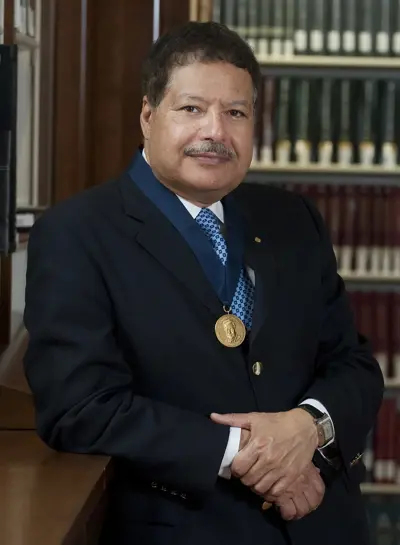
Ahmed Hassan Zewail was an Egyptian-American chemist, known as the "father of femtochemistry". He was awarded the 1999 Nobel Prize in Chemistry for his work on femtochemistry and became the first Egyptian to win a Nobel Prize in a scientific field. He was the Linus Pauling Chair Professor of Chemistry, Professor of Physics, and the director of the Physical Biology Center for Ultrafast Science and Technology at the California Institute of Technology.
