Albert Pike Quotes
Less glory is more liberty. When the drum is silent, reason sometimes speaks.
Pike, Albert. Morals and Dogma of the Ancient and Accepted Scottish Rite of Freemasonry. Supreme Council of the Thirty-Third Degree for the Southern Jurisdiction of the United States, 1871, p. 72.


As hard as it is for us to imagine today, while her husband was President of the United States, the First Lady wrote a nationally syndicated newspaper column every single day with politics frequently the subject. While she usually agreed with the President, there were occasions where they seemed to not see things exactly the same. She tended to be more liberal than he. However, there were those who believed that when she criticized politicians, it was with FDR’s knowledge and blessing and she sometimes did his “dirty work.” Eleanor Roosevelt was one of the most influential people in the country—certainly more-so than any First Lady before and since.


This idea came from Dutch Philosopher Benedict Spinoza. See his quotation from 1677.


He was subpoenaed by the House Un-American Activities Committee where he was accused of being a Communist which he eloquently denied starting with this statement. He died of a heart attack 3 days later. However, most historians agree that White passed classified information to the Russians. He was accused of being a Communist, but there was never any evidence of that. Some people believe that he was a spy for the Russians and committed espionage, but others disagree observing that White was very much his own man and felt that much information that was classified never should have been. White substituted his own judgment, it is believed, about what could be given to the Russians for the security system. He was an admirer of what Russian socialism had accomplished economically, educationally and medically since the 1917 revolution deposing the Czar. Russia had been a valuable military ally, which had taken the brunt of both military and civilian casualties in WWII. White’s economics were certainly not Marxist but very much Keynesian.


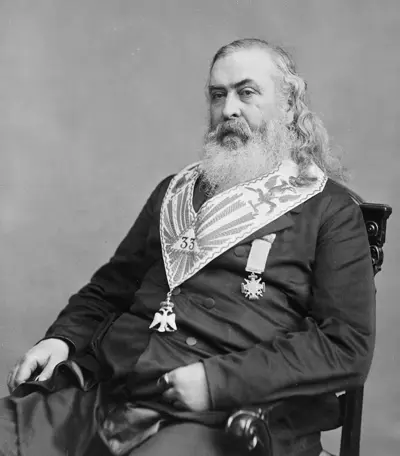
Albert Pike was an American author, poet, orator, editor, lawyer, jurist, and prominent member of the Freemasons. Pike was a senior officer of the Confederate States Army who commanded the District of Indian Territory in the Trans-Mississippi Theater of the American Civil War. He then served as an associate justice of the confederate Arkansas Supreme Court from 1864 until the surrender of the Trans-Mississippi Department of the Confederation in May 1865.
