John Law Quotes
Land will continue to rise in value, being yet capable of Improvement; And as the Demand increases, for the Quantity will be the same
John Law, 1671-1729, Scottish Economist, Money and Trade Considered: With a Proposal for Supplying the Nation with Money, 1705
Sourced by: Eigen's Political and Historical Quotations


The colony, Darien, failed as the Spanish evicted the colonists. Yet Holland’s economic view of the advantages of international trade was remarkably prescient.

This is the equivalent of “if you build it, they will come.” This is one of those so called “Law” of economics that is really not always so. In many cases it holds, as when Disney Built Disney World or Apple issued the iPhone. However, it clearly does not hold when there is a surplus of a commodity.

Note that although the industrial revolution was beginning, the value of factories, inventory, machines, and raw materials were not yet recognized by some of the leading intellectuals of America. The perspective was totally agricultural.


Speculation meant real estate investment and business.


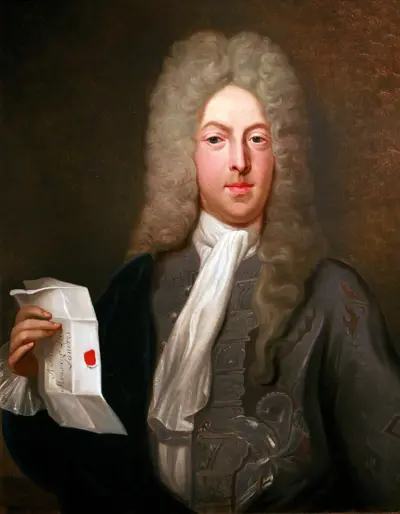
John Law was a Scottish economist who distinguished money, a means of exchange, from national wealth dependent on trade. He served as Controller General of Finances under the Duke of Orleans, who was regent for the juvenile Louis XV of France. In 1716, Law set up a private Banque Générale in France. A year later it was nationalised at his request and renamed as Banque Royale. The private bank had been funded mainly by John Law and Louis XV; three-quarters of its capital consisted of government bills and government-accepted notes, effectively making it the nation's first central bank. Backed only partially by silver, it was a fractional reserve bank. Law also set up and directed the Mississippi Company, funded by the Banque Royale. Its chaotic collapse has been compared to the 17th-century tulip mania in Holland. The Mississippi bubble coincided with the South Sea bubble in England, which allegedly took ideas from it. Law as a gambler would win card games by mentally calculating odds. He originated ideas such as the scarcity theory of value and the real bills doctrine. He held that money creation stimulated an economy, paper money was preferable to metal, and dividend-paying shares a superior form of money. The term "millionaire" was coined for beneficiaries of Law's scheme.
