George S. Patton Quotes
Kill all the Germans you can, but do not put them up against the wall and kill them. Do your killing while they’re still fighting. After a man has surrendered, he should be treated exactly in accordance with the Rules of Land Warfare, and just as you would hope to be treated if you were fool enough to surrender… Americans do not kick people in the teeth after they are down.
Sourced by: Eigen's Political and Historical Quotations

The note was found in an abandoned Japanese camp on Bataan. There are some who believe that this note was a forgery. However, most think it genuine as it reflected one of the Japanese
“aces in the hole” to defend against an allied invasion of the Japanese mainland. It was one of the reasons that some American planners advocated use of the Atomic Bomb. Of course that was a real risk of using the bomb. The Japanese might be so angry and feel morally abused and kill the many allied prisoners they had. Many thought it was a lesser risk because it did not have the symbolic animus that foreigners occupying the Japanese homeland had. The quotation illustrates the amazing complexity that the American and allied leadership faced trying to end WWII in the Pacific.

When the Union army began using Blacks as recruits, the South threatened to execute any Negro soldier they captured. Some Southerners opposed execution but favored enslavement of captured Northern Black soldiers. The Lincoln threat seems to have worked, although Lincoln opposed executing Southern officers in retaliation for the atrocities at southern prisoner of war camps


There has always been some confusion in the case of the Wars in Afghanistan and Iraq. The Geneva and Hague conventions are very clear when prisoners are official members of an state’s armed force with uniforms, insignia and ranks. It is also clear with respect to civilians. But the combatants of the insurgent and terrorist forces fall in between, and international law is less clear. The George W. Bush administration at first took the position that the captured combatants were not captured soldiers and were therefore not entitled to the treatment due that status. But the military regulations made no distinction as to how prisoners in combat should be treated. It is a very gray area, except that in either case, torture is illegal under U. S. and under International law.


Germany had invaded and occupied much of Europe. These two fronts accounted for the majority of the German casualties. The Germans not only violated the Geneva Convention and the Laws of War repeatedly, but as you can see from this quotation, it was deliberate policy. Keitel was tried and hanged after the war. See {621438} .

While the Abenaki Indians were vicious warriors and committed many atrocities on their raids of upper NY State, they treated their prisoners extremely well.

On March 9-10, 1945, over three hundred B-29 Superfortresses loaded with 2,000 tons of incendiary bombs flew over Tokyo bombing the city in waves for 6 hours. Over 250,000 buildings were destroyed and more people were killed than would be in either Hiroshima or Nagasaki which were destroyed by atomic bombs. See {615730} and {615733}. The technique called area bombing was then implemented on Japanese cities 66 more times. Stimson was seriously worried that there would be no large targets in Japan left on which the dramatic effect of the atomic bomb could be demonstrated. And without such a demonstration, there would not be a likely Japanese surrender as all the devastating conventional bombing had not persuaded the Japanese. A land invasion with perhaps millions of casualties might be required.

Although generally a right wing conservative, Clark today sounds like almost like an extreme leftist on the issue. At the time however, many thought that he had taken leave of his senses. He not only was completely contrary to bipartisan national policy but opposed by almost universal American public opinion. He is one of the very few significant American officials to oppose the war policies.

In the Afghanistan and Iraq Wars the U. S. government was much criticized for not treating captured Taliban and others as prisoners war. This Article is their main justification. The Taliban and Al Quida did not meet most of the criteria and therefore the convention did not apply to them.
This clause applied to German POWs in America caused a problem for Blacks in the military were harshly discriminated against by a then discriminating country. The result was that Nazi POWs did not have to move to the back of a theater while the Back GIs were required to, and a host of other gross indignities.


Adolf Eichmann was a German Nazi war criminal who had been responsible for the murder of millions of people. At the end of WWII, he had escaped Germany and was living in South America. Israeli agents found him, kidnapped him, and brought him to Israel. There he received a very public trial, was found guilt, and executed. In the War on Terror at the beginning of the 21st century, the key terrorists that were captured in Afghanistan were sent to a special prison base in the American part of Cuba. They were held there but at first received no trials or hearings. They were not prisoners of war, and not criminals where there were legal procedures for handling them. This was a new area. Some argued that they should all get trials. The Supreme court ruled that they at least had to get hearings. The correct handling was a major debate.


During the Seminole War, Ross, as a very respected Cherokee Chief and leader, had been asked to persuade some if the Seminole Chief’s to come to a conference to discuss and negotiate a settlement to the conflict. Ross was successful . Seminole Chief Micanopy, twelve other chieftains, and a number of Seminole warriors accompanied the Cherokee deputation to the headquarters of the United States Army at Fort Mellon, where they were to discuss the matter. When they arrived General Thomas Jesup arrested the Seminoles instead of negotiating. Ross, a very educated man who was literate in English, o the Secretary of War. Jesup in retrospect was one of the disgraces in the history of the U. S. Army was admired, not for his fighting or his lack of ethics, but for his management and logistics as the Quartermaster General. For more quotations showing Jesup’s character, see quotations 643611 and 643612.

The German Generals talked him out of the idea, but the quotation gives an insight into the Character of the German Leader. It never occurred to him that the Russians might retaliate and murder German prisoners.

Lawrence of Arabia. In the Middle East, Lawrence led a small Arab army against the Turks and the Germans. In a battle near Tafas, the captured 250 Turkish and German soldiers as prisoners. They them shot them all in cold blood with their Hotchkiss machine gun. What makes this quotation so significant is that one of the great British heroes of WWI was actually guilty of War Crimes. An American journalist gave Lawrence and his exploits great publicity without mentioning the atrocities. The British chain of command also ignored the transgression of one of the most fundamental rules of war even though the clear evidence was in basic battle report files. However, the British never removed the report from the files or destroyed it. The Turks and the Germans while they respected the rules of war with the English, French, and most allies, treated the Arabs much more harshly and murdered Arab prisoners on many occasions. In part this atrocity at Tafas was an act of vengeance and retaliation. But Lawrence never even tried to explain it.

The Scientific Project that developed the Atomic Bomb. The focus of the scientists had been to beat the German’s who were terribly evil might develop a bomb first. After the defeat of some scientists began to have concerns about their purpose. Most were very distrustful of the army and believed little of what they were told, by the military at Los Alamos. However, in a remarkable our de force of leadership, Oppenheimer had the trust of virtually all of the staff. This memo and a briefing of the invasion plans of mainland Japan (see {629858} ) convinced the scientist to maintain their intense and punishing pace.


aware of the atrocities inflicted on Union prisoners of war at Confederate Prison Camps His testimony was corroborated, and the Commandant of Andersonville was found guilty and hanged.

While there were atrocities committed by both sides in the Civil War, the proportion tended to be heavily weighted by Confederate perpetrations. The Confederate officers were not appointed by the command structure and under strict military discipline, but they were elected by the troops and could be so removed (except for the general officers who were appointed by the confederacy). Also, the confederate troops were not as well fed or supplied as the North and they had fewer resources with which to fulfill their obligations to prisoners. In a number of battles, ill-clothed soldiers stripped the Union dead, wounded and prisoners, often naked to use their shoes, blankets and clothing, Union prisoners of war were much more badly abused in the prisoners of war camps like Andersonville which were not under the command of Robert E. Lee.

The general was replacing George S. Patton as commander of the Third Army. Patton had opposed the deNazification policy of the allies and caused a great deal of public relations difficulty for the army command and the administration, as reporters would frequently print his views. Truscott was one of Patton’s loyal assistants. The minute he took over, the press wanted to find out if his views were the same as his former boss regarding the Nazis. They were quite different. Reporters had no story.
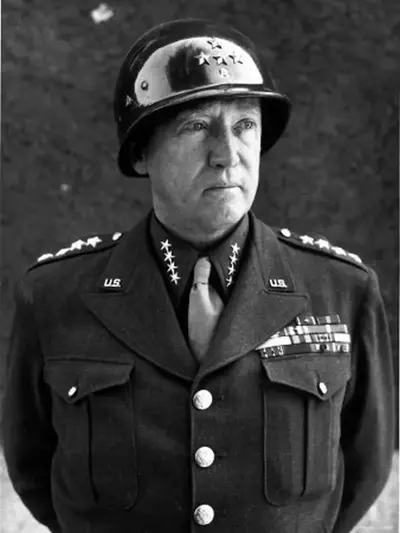
George Smith Patton Jr. was a general in the United States Army who commanded the Seventh United States Army in the Mediterranean theater of World War II, and the Third United States Army in France and Germany after the Allied invasion of Normandy in June 1944.
