Henry Demarest Lloyd Quotes
Kerosene has become, by its cheapness, the people’s light the world over … Very few of the forty millions of people in the United States who burn kerosene know that its production, manufacture, and export, its price at home and abroad, have been controlled for years by a single corporation—the Standard Oil Company…. The Standard produces only one fiftieth or sixtieth of our petroleum, but dictates the price of all, and refines nine tenths. Circulars are issued at intervals by which the price of oil is fixed for all the cities of the country, except New York, where a little competition survives … This corporation has driven into bankruptcy, or out of business, or into union with itself, all the petroleum refineries of the country except five in New York, and a few of little consequence in Western Pennsylvania …
The only previous source of light in America had been whale oil or candles—both very expensive. Oil was discovered in Pennsylvania and refinery techniques developed to produce Kerosene. (Gasoline was too explosive and dangerous for home use.) Everyone’s standard of living depended on Kerosene at the time and John D. Rockefeller controlled the price everywhere except New York. There were no monopoly or antitrust laws when he gobbled up his competitors and he rapidly became the richest man in America and one of the most hated. His abuse of the system at the time led to the government regulation of monopolies and the antitrust laws. It was very courageous for the Atlantic Monthly to publish this article, as Rockefeller’s power extended all over the nation—but less in New York where the magazine was published.
Henry Demarest Lloyd, 1847-1903, Mugwump Writer & Reformer, “Monopoly on the March”, The Atlantic Monthly, March 1881
Sourced by: Eigen's Political and Historical Quotations


She had done a monumental exposé of the Standard Oil Company illegal and immoral activities. The public was so aroused that many reforms were instituted and the Standard Oil Company Trust was broken up into many smaller companies. Tarbell was then, in the words of S. S. McClure, “the most famous woman in America.”


Here, an officer of a large corporation (Pittsburgh Plate Glass) makes the classic argument of large corporations about the anti-trust laws which prevent them from using their economic power to crush competition. The claim that the large corporations are at a disadvantage and handicapped in competing with small companies is easily refuted by the bankruptcy rate of small businesses which is large, and that of large corporations which is very small, and that of major monopolies which is virtually zero.

The three richest men in America—John D, Rockefeller, Andrew Carnegie, and Morgan, usually major rivals—had gathered together to decide what to do about William Jennings Bryan, who they viewed as very hostile to business and capitalism. (See {641037} and {641038} for Bryan quotation examples that concerned them.) They agreed to combine their efforts and back William McKinley who was running for the Republican Presidential nomination. In those days, the nominee was chosen by a small group of party leaders and their resources guaranteed McKinley the post. They then put large amounts of money to campaigning against Bryan and for McKinley including dirty tricks, many of which are illegal today. It is not known for certain whether McKinley knew the extent of the involvement of the monopolists, but shortly after assuming the Presidency he cut back on many of the relatively few regulations that then existed to control unbridled capitalism. Their effort went for naught when McKinley was assassinated and Theodore Roosevelt became President. Roosevelt would not be bribed or intimidated, and he did more to control monopolies than even Bryan would likely have.

At the time, the Chamber of Commerce represented the small and medium business which were being decimated by the large businesses and their monopolies. A century later, the Chamber became a creature of the large business and their money and by 2010, the Chamber had virtually become the representative of the large businesses outside of the high technology field and had become a campaigning arm of the Republican Party, In 1880 however, they called public attention to the abuses of the large corporate monopolies.


Most companies in a capitalistic system compete mightily to obtain monopolistic positions so they can avoid capitalistic competition thereafter.


At the time, there was generally only a single newspaper in an area in New Zealand.
Patents, copyrights, and franchises are but 3 common (and legal) ways of obtaining a onopoly position.See Adam Smith {627790} for a similar thought.

The President had decided to aggressively push for railroad regulation to end the rate rebate abuses that were used to support the monopolies like Standard Oil. In vintage Roosevelt tactics, he gave his first major speech on the subject in the setting and forum that would be most opposed to it. The Union League Club of Philadelphia in included the wealthiest men in the area where were most opposed to any Federal Regulation of anything. All the major railroad executives and stock owners and traders were also members. The President wanted to persuade the opponents to change their positions, and sometimes he did. He also was driven by his concept of sports and athletics so that the “opposition” should have “fair notice” for the contest ahead.

The “rebate agony” referred to a corrupt practice of the Railroads and the Large Monopolies. The railroads charged a very high rate for the transportation of important products like beef and oil. However, secretly they gave back a large percentage of the transportation rate charged to the trusts. They in turn could cut their prices and undersell all the smaller competitors who were paying “full freight” and could not afford to match the lower price. As soon as the smaller competitors were driven out of business in an area, the trust raised its rates even higher than they charged originally. The Railroad had made a small but reasonable profit on the freight of the trusts but they were guaranteed all their business. They also made huge profits on the higher rates that the small companies paid until those companies were driven out of business. Journalists like Ray Baker and Ida Tarbell had uncovered the rebate scheme which enabled the trusts to steal high amounts from the general public through unreasonably high prices. President Theodore Roosevelt was committed to try and regulate the railroads and not allow rebates but charge the same public rate to all with no rebates. Socialists like Sinclair, thought that this attempt would be hopeless—that the damage had already been done, and the trusts now had so much money that they could buy state legislatures and many in Congress to preserve their dominance.


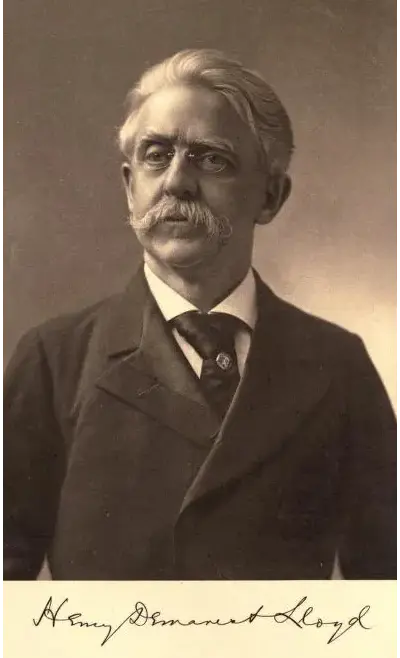
Henry Demarest Lloyd was a 19th-century American progressive political activist and pioneer muckraking journalist. He is best remembered for his exposés of the Standard Oil Company, which were written before Ida M. Tarbell's series for McClure's Magazine.
