W. E. B. Du Bois Quotes
It is the growing custom to narrow control, concentrate power, disregard and disfranchise the public; and assuming that certain powers by divine right of money-raising or by sheer assumption, have the power to do as they think best without consulting the wisdom of mankind.
W. E. B. Du Bois, 1868-1963, Educator and author, Autobiography
Sourced by: Eigen's Political and Historical Quotations


This quotation has much more meaning that similar statements of dozens of other people who claimed Bush should be impeached. The reason is that Fine was a strong conservative wanting to impeach a conservative President and he was the person who drafted the articles of impeachment against President William Clinton which passed the House but Clinton was acquitted by the Senate. So Fine was generally seen as a partisan for Republican Conservatives like Bush and a man who acted strongly against Clinton, and yet he observed in this quotation that Bush’s crimes were more serious. See {583797} for a concurring view on impeachment of Bush.

The President had decided to aggressively push for railroad regulation to end the rate rebate abuses that were used to support the monopolies like Standard Oil. In vintage Roosevelt tactics, he gave his first major speech on the subject in the setting and forum that would be most opposed to it. The Union League Club of Philadelphia in included the wealthiest men in the area where were most opposed to any Federal Regulation of anything. All the major railroad executives and stock owners and traders were also members. The President wanted to persuade the opponents to change their positions, and sometimes he did. He also was driven by his concept of sports and athletics so that the “opposition” should have “fair notice” for the contest ahead.


The Bank was privately owned. Jackson was a major opponent of the Bank. See his description {630650} .


The only previous source of light in America had been whale oil or candles—both very expensive. Oil was discovered in Pennsylvania and refinery techniques developed to produce Kerosene. (Gasoline was too explosive and dangerous for home use.) Everyone’s standard of living depended on Kerosene at the time and John D. Rockefeller controlled the price everywhere except New York. There were no monopoly or antitrust laws when he gobbled up his competitors and he rapidly became the richest man in America and one of the most hated. His abuse of the system at the time led to the government regulation of monopolies and the antitrust laws. It was very courageous for the Atlantic Monthly to publish this article, as Rockefeller’s power extended all over the nation—but less in New York where the magazine was published.


In Rhodes’ era money not only bought and influenced politicians but it enabled rich people and their companies to have their own armies and follow their own foreign policy. The British government has a long history of finding a proper balance of control over British wealthy men and her companies doing everything from enforcing the law to invading other countries. Without the companies, the management of the huge empire would have been too expensive and with them, the citizens and the government lost control of foreign policy. In the end, the latter was unacceptable and the British Empire was just too Expensive to maintain where so any nations wanted independence.

Goldman Sachs, one of the largest worldwide financial corporation, not only spent millions on lobbyists to shape government law and regulation, but its ex-officials served on high government positions including Treasury Secretary. They also give large amounts to finance campaigns of Congressmen and other public officials who were then very sympathetic to Goldman Sachs’ welfare. There is no practical way a citizen voter can overcome that situation, especially by exercising the voting franchise.

The commercial special interests, together with the banks had become a very dominant force in society just as before the Great Depression in 1929 and the Great Recession in 2008.

By the middle of the 20th century, the banks were no longer allowed to control the railroads and seemed less powerful, but by the beginning of the 21st century, the few largest banks, without the railroads or any other industrial holdings, were so big that the controlled credit, fraudulently manipulated rates and mortgage foreclosures and after losing huge amounts speculating in 2008, the government had to bail them out with taxpayer money while the bank executives who caused the failures tool million dollar bonuses. Never were banks so powerful in any country that they could have the government pay billions of dollars for their losses and mistakes.

Abrams had a long track record of defending the 1st Amendment that he was generally perceived as a liberal. However, he was the winning Attorney for Citizens United where the Suprme Court ruled 5-4 that spending money on campaigns was a form of speech and the government may not regulate the amount of speech (money) for a corporation of a person.

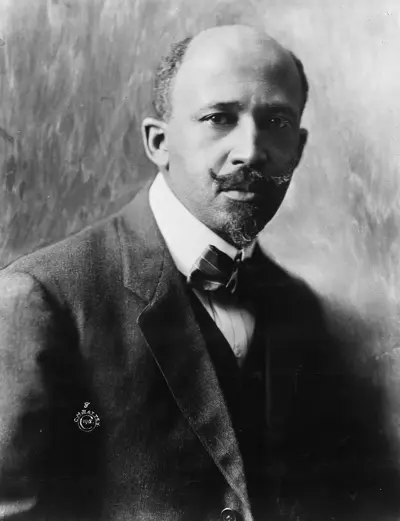
William Edward Burghardt Du Bois was an American sociologist, socialist, historian, and Pan-Africanist civil rights activist. Born in Great Barrington, Massachusetts, Du Bois grew up in a relatively tolerant and integrated community. After completing graduate work at the Friedrich Wilhelm University (in Berlin, Germany) and Harvard University, where he was the first African American to earn a doctorate, he became a professor of history, sociology, and economics at Atlanta University. Du Bois was one of the founders of the National Association for the Advancement of Colored People (NAACP) in 1909.
