Louis Armstrong Quotes
It’s getting almost so bad a colored man hasn’t got any country…. The way they are treating my people in the South, the government can go to Hell!
Armstrong rarely commented on politics (see {615854}), but the Governor defying the Supreme Court and not letting his people even go to school with other students was too much for him. He not only made the statement, but he approved it for publication. This shocked many who knew him as an apolitical person. He was particularly distressed with President Eisenhower who although he had warned Faubus that he would enforce the court order and then used federal troops to do so, Eisenhower was a man of action and not rhetoric and his lack of firm public statements overlooked an opportunity to use the Presidential “bully pulpit” and exercise his moral leadership and authority. Many then, and even 50 years later, were not sure where he stood on the issue of school desegregation. See {615852}.
Louis Armstrong, 1901-1971, Musician & Entertainer, Statement to reporter, Larry Lubenow in Grand Forks, ND, when Arkansas Governor Faubus ordered the national guard to, despite a court order to the contrary, prevent Black students from integrating Central High School in Little Rock, 1957
Sourced by: Eigen's Political and Historical Quotations

Armstrong rarely commented on politics (see {615854}), but the Governor defying the Supreme Court and not letting his people even go to school with other students was too much for him. He not only made the statement, but he approved it for publication. This shocked many who knew him as an apolitical person. He was particularly distressed with President Eisenhower who although he had warned Faubus that he would enforce the court order and then used federal troops to do so, Eisenhower was a man of action and not rhetoric and his lack of firm public statements overlooked an opportunity to use the Presidential “bully pulpit” and exercise his moral leadership and authority. Many then, and even 50 years later, were not sure where he stood on the issue of school desegregation.

Historically, the Southern reaction to early 20th centry Civil Rights efforts was that it was the work of communist and anarchist radicals who were trying to destabilize America. When that argument began to be exposed as false, the next line of defense was that the southern Negro was perfectly happy in the segregated South, and the only problem was Northern liberals, black and white, who came to the South to foment trouble.


At the time, racial discrimination was so rampant in America that when one of the units of Pepsi Cola, under the leadership of Walter Mack, hired Emmons to sell to Black communities, the Black residents of Northern communities were so unused to seeing Blacks in a “white collar” job, that they were treated as celebrities. Emmons and a few other black salesmen had incredible results yet despite that, the practice did not grow at the time as there were too many white executives who were so prejudiced that the practice was not increased after Mack retired. This short quotation paints a good picture of the nature of racial job discrimination in the North prior to WWII.

Defending his action of using national guard troops to prevent school integration:

Wilson, a history and government professor and college president before politics, was has been accused of being one of the most racist Presidents since Reconstruction. Prior to his Presidency, the Federal Government had been making steady progress in hiring African Americans. Under Wilson there was a wholesale firing of a large proportion of them. Some apologists argue that his League of Nations and other major aspirations required the votes and cooperation of Southern Senators who insisted that many of the blacks be terminated. At the same time, the KKK was near the zenith of its membership and political power and was an intimidating force. Wilson’s home state of New Jersey not only had a large KKK membership but there were lynching of Blacks in his own state and when Governor and President he never asked for any anti-lynching legislation.


Reconstruction was the period in the South after the Civil War. The change that emancipation brought to the white South was traumatic, and there was a constant struggle between those who wanted the Blacks to be integrated into Southern Society—and those Southerners who wanted to create a society that would be as close to slavery as possible, So the Klu Klux Klan and other terrorist organizations formed and with lynching and other intimidation, much of the initial progress of Reconstruction was rolled back and did not get reinstated until the Civil Rights and Voting Rights Acts were passed in 1964.


Justice Marshall, in he early career played an extremely important role in the development of the law vis a vis race and discrimination in America. He went from town to town in the Jim Crow, segregated South filing and often winning civil rights lawsuits. This was an era where lynching was still prevalent, and he was often threatened with bodily harm or death. Justice Ginsberg who also had been a leader in filing and winning civil rights suits but she worked in the area of women’s rights. The host had stated that she and Marshall were the great legal pioneers in civil rights litigation. Ginsberg explained that she hers was a much easier role and Marshall should receive much more credit. This was her reason.


What America just could not believe that American Negroes were not satisfied with their second class status. So any organized Negro unrest must be caused by un-American and foreign influences or those of radicals like Socialists. The Socialists were among the first organized political groups to condemn the racism and discrimination of the day. Later, even at the crux of the civil rights movement in the 1960s, most Southerners maintained that all the dissatisfaction and unrest of Negroes was the result of “agitators,” “foreigners,” “socialists,” and “communists.”

The statement was made even more dramatic as the outgoing Governor, Lester Mattox, standing behind Carter at the ceremony, was an arch segregationist.

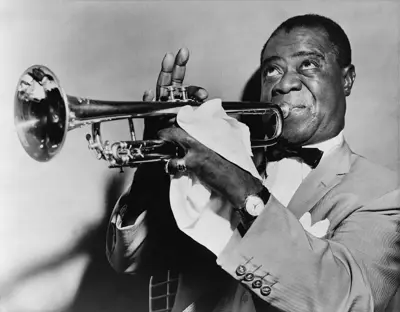
- Born: August 4, 1901
- Died: July 6, 1971
- Nationality: American
- Profession: Musician, Singer
Louis Daniel Armstrong, nicknamed "Satchmo", "Satch", and "Pops", was an American trumpeter and vocalist who was among the most influential figures in jazz. His career spanned five decades and different eras in the history of jazz.
