James Brown Ray Quotes
It is useless to try so frequently and unsuccessfully, attempt upon attempt, to instruct the great mass of people in the art of war
Even in a relatively frontier state like Indiana at the time, there was little enthusiasm for a militia. See {613320}.
James Brown Ray, 1810-1892, U. S. Senator (Non Partisan, Indiana), Governor of Indiana (Non Partisan), Message to the State Assembly
Sourced by: Eigen's Political and Historical Quotations

Governor Noble himself was a Colonel in the Indiana Militia. Even in a relatively frontier state like Indiana at the time, there was little enthusiasm for a militia. See {613320}.


Washington was not a fan of the militia. It was however preferred by much of Congress who favored local institutions rather than national ones. Competence gave way to politics then as often it does in modern times. See {613015}, {613016}, {613022}, {613027}, {621987}, {621988}, {613030}, {613033}, & {613056}.

The lack of military preparedness of the United States for the First World War by then was evident and a major subject of political discussion. Mitchel was a “hawk” for his day. He was defeated the next year and joined the military flying service but died in 1918 when he forgot to fasten his seat belt in the airplane and fell from the plane to his death.


This quotation is very controversial among historians. Beverly was in a sense the first American historian, although he had no formal training. His extolling the military and sharpshooting virtues of his fellows may or may not have been an exaggeration both as to their skill with firearms and their ability as soldiers. There is much evidence that only a minority of the people of Virginia possessed firearms at the time yet Beverly’s image is the one that has come down to us in the romanticized view of early America. Even fellow Virginian, George Washington {613056} complained that his Virginia civilians made poor soldiers compared with “regulars” who had been trained to shoot, and when Virginia militia reported for duty less than one quarter had firearms which were very expensive and not very accurate at the time.
Even today many Americans believe the myth that the American colonial citizen was a skilled marksman who existing skill and familiarity with guns carried the day in the American Revolution. However, even General Washington had to dispel the myth. It was bad politics for members of Congress and other public officials to criticize the local citizenry militias regardless of how inept they were. Less than one fourth of the militia even owned guns and most were unfamiliar with how to use them. Perhaps one of Washington’s greatest military accomplishment was his choosing Van Stuben and other European officers who did such a good job of training a regular army. See {613015}, {613016}, {613022}, {613027}, {621987}, {621988}, {613030}, {613033}, & {613056}.

If a military loses a war, it has shown to be insufficient quality; if it wins, the evaluation is good. With all the talk about what makes for an effective and quality military, as the General states, it is war that is the final arbitrator. So ideally we never want to really know how good our military is.


More than a decade before Hamilton wrote this, a Maryland commission used the phrase “well regulated militia” earlier. (See {588394}.) It would be less than 2 years before the phrase “well regulated militia” would be added into the Constitution in the 2nd Amendment of the Bill of Rights—September 25, 1789. The Maryland resolution was the last of several passed at a meeting by which Maryland endorsed resistance to the British before the actual Revolution. So these resolations would have been widely distributed throughout the colonies and known by the leaders. Whether the drafters of the 2nd Amendment got the phrase from Hamilton’s Federalist 29 or from the Maryland Resolutions is not known but Hamilton’s was much more current. Did he get the phrase from Maryland? Did Congress get it from him? Did Maryland originate the phrase or was there an earlier use that influenced the Maryland drafters? At this point no one is sure, but the phrase is critical to the meaning of the 2nd Amendment because the Supreme Court has repeatedly held that the Second Amandment does not apply to individuals but only to the State’s right to bear arms within the “well regulated militia” and not as individual citizens. The right is that of the State government and that is why a state can control guns including banning them if they choose. So an individual in America does not have the constitutional right to bear arms. He may have a state constitutional right but in other states he may not use a gun in certain places and may not possess certain types of guns like hand guns which are illegal in New York, Washington DC and some other places.

The issue of how to raise an army plagued the Founding Fathers. The State Militias had very short enlistment periods so that as soon as the soldiers had been trained and were effective, their enlistments would be up. Washington and others wanted a draft or at least long enlistment periods in an American Army. The debate which then began has never ended. How much regular Army as opposed to the Army Reserves—the equivalent of the State Militias, whether or not there should be a draft, whether or not an enlistment period may be extended if there is a military need—none of these are new issues but have been with us since the country was founded. See {591369} for more of Washington’s view of this issue.


For most of the history of the United States – especially in the governments of our Founding Fathers, there was an extreme antithesis to defense spending and military preparedness a fact that conservatives who look to the Founding Fathers as models and legal precedents for everything that we do today generally do not realize as they lobby for defense spending. The change really took place after Pearl Harbor and WWII where America was totally unprepared for war.
Washington was very unhappy with militia even from his native Virginia. See also {613030} This quotation is very important because the common belief is that all Americans in Colonial America were skilled with a gun and that there was a strong gun ownership culture. Many people quote {613057}. However, that was not the case as this and other research has shown. Less than one quarter of the Virginia militia had any weapon. Guns were expensive and only a minority of Americans could afford them. Despite the image of sharpshooters, and there were some, most guns were very inaccurate in the hands of most men.


This issue of who has the wisdom and competency to determine policy in matters of war has been a constant one in most societies. Even in the Iraq war of the early 21st century, the Congress and the President argued as to what competence the Congress had to determine policy, strategy and tactics.


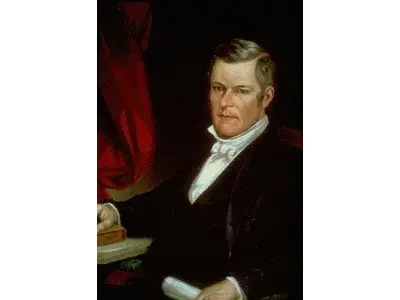
- Born: February 19, 1794
- Died: August 4, 1848
- Nationality:
- Profession:
James Brown Ray was an Indiana politician and the only Indiana Senate president pro tempore to be elevated to governor of the State of Indiana. Ray served during a time when the state transitioned from personal politics to political parties, but never joined a party himself. Taking office one week before his 31st birthday, he became the state's youngest governor and served from 1825 to 1831, the longest period for an Indiana governor under the state constitution of 1816. During Ray's term as governor the state experienced a period of economic prosperity and a 45 percent population increase. He supported projects that encouraged the continued growth and development of the young state, most notably internal improvements, Native American removal, codification of Indiana's laws, improved county and local government, and expanded educational opportunities. Ray was known for his eccentricity and early promotion of a large-scale railroad system in the state. His support for new railroad construction and alleged involvement in several scandals caused him to lose popularity among voters. Ray's opponents who favored the creation of canals considered railroads to be an impractical, utopian idea. Following Ray's departure from political office, he continued to advocate for a statewide railroad system until his death in 1848.
