Henry David Thoreau Quotes
It is a thorough process, this war with the wilderness - breaking nature, taming the soil. feeding it on oats. The civilized man regards the pine tree as his enemy. He will fell it and let in the light, grub it up and raise wheat or rye there. It is no better than a fungus to him.
Thoreau, Henry David. The Journal of Henry David Thoreau, 1837-1861. Houghton Mifflin, 1906.


Clinton was a founder of the society. In his view, and that of many others, this was the essential problem facing the Indians and whites in North America. It was also a problem between agricultural Indian tribes and those that were hunter-gatherers. The whites of the time were predominantly agriculturalists. The hunter gatherer requires much more land per person than does the farmer. Agriculture allowed progress and development, but at the same time, it curtailed and eventually ended hunter-gatherer cultures nearby. Over time, the latter either became agricultural communities or degenerated and/or disappeared.


In America that had almost happened as the farmers were at the mercy of the railroad monopoly in any one area.

The treaty was signed by a number of people including the Navajo leaders but Sherman or his staff drafted most of it. Sherman also had the title then of Indian Peace Commissioner.

The reason for the secrecy was that he was informing Congress of the Lewis & Clark Expedition. Potentially, the Spanish, English or French might try to interfere with the expedition which was the precursor to American domination of the entire continent. Unfortunately, Jefferson’s plan for the Indians was not supported by many other Americans with the exception of New York State and the Iroquois remaining after many left after supporting the British in the Revolution. But the Iroquois who remained were already farmers in fixed communities and were experienced traders. Further, they had a complex governmental structure with many elements of democracy, and several had already succeeded in European educational settings. Their successful integration with the rest of New York can be demonstrated by the fact that New York is the only state where the average Native American Income is the same as the average white income, and there is no Indian gaming in New York. Jefferson’s vision, unfortunately, was never implemented in early the Westward Expansion.

40 years later, it was clear that he was correct about the possibility of man directing his own evolutionary future. It was also clear that man was doing just that by his effect on his own ecosphere and other humans. However Beadle envisioned an intentional planned set of actions, taken by society as a whole. However, in most counties the political system has not been very facile at examining the alternatives with the advice of scientists. In the United States about half of the politicians reject the information provided by the overwhelming majority of the scientists, and the great challenge was whether in the future man will knowingly and with forethought affect his evolution or with ignorance and unintended consequence will do so.

Cahokia was a very large Native American city just across the Mississippi River from St. Louis. In 1250, its population was about 15,000, comparable to that of London or Paris during the same period. At the time of the American Revolution, it was larger than New York, Boston of Philadelphia having 40,000 inhabitants at its peak. Tiahuanaco was a large city—30,000 at its peak—in Bolivia. The very ability to create and sustain such large communities shows that the Indians of the Americas were not simply hunter-gatherers but were very sophisticated in manipulating their environment and organizing large numbers of people.

Environmentalists counter with the fact that the corporate and government interests in growth at any cost will, and have in the past, found a loophole in every reasonable compromise that has been made. Reasonableness is only a device they use to slow regulation until they can either figure out a loophole or use their great fiscal resources to shape public thinking to soften or eliminate the regulation. Therefore some environments argue that they must be as ideological about the environment as the corporations are about their rights to profit and not compromise even when a compromise appears reasonable. Besides, if the corporations always appear to win, the public will think opposing them is futile. So when they can be beaten on something that is unreasonable, they appear weaker and encourage more environmental public activism.
Under the WWI Peace Treaty the high court of Egypt was an International Court. President Wilson nominated Crabites to this court and he served there for 3 decades during which he became a world class expert in Middle Eastern affairs.
1700 scientists, including the majority of the American Nobel Prize Winners in Science, personally signed this 1992 warning about the environment.


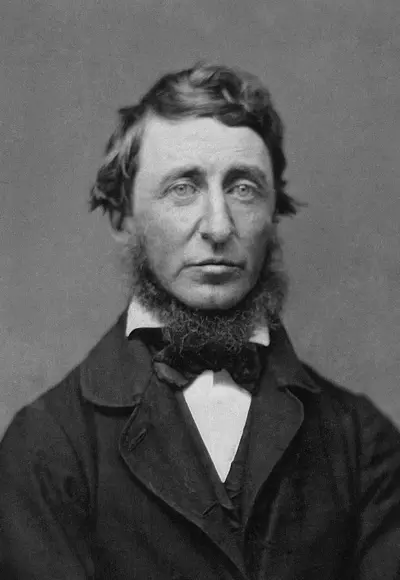
Henry David Thoreau was an American naturalist, essayist, poet, and philosopher. A leading transcendentalist, he is best known for his book Walden, a reflection upon simple living in natural surroundings, and his essay "Civil Disobedience" (originally published as "Resistance to Civil Government"), an argument for disobedience to an unjust state.
