Fyodor Dostoevsky Quotes
The railroads were built at the expense of the destruction of agriculture.
In America that had almost happened as the farmers were at the mercy of the railroad monopoly in any one area.
Fyodor Dostoevsky, 1821-1881, Russian Writer, Quoted in Walter Moss, Alexander II and His Times
Sourced by: Eigen's Political and Historical Quotations

Arguing that Slavery inhibited a society from development ...


Bonnycastle was one of the earliest visionaries of a transcontinental railroad. The Canadian version however was constructed after the United States.


The Mormon settlement of the West has, from an economic development point of view, produced a successful model that few have ever even approached. Using techniques that ranged from classic capitalism to classic socialism, they blended both systems into a unique structure of their own. The results were spectacular despite the fact that the Mormons faced boycotts from manufacturers throughout the country and could borrow no money from banks, and never received any financial help from the Federal or any other government but their own. Even if they had gone into heavy debt, the results would have been spectacular, but achieving all that without any debt whatsoever is one of the most successful economic developments in the history of the world.

Because as an economist, Galbraith acknowledged the Soviet successes in steel, heavy military weaponry, many conservatives thought he was very left wing. However Galbraith was one of the first to identify the economic weaknesses of Russia.


What Mises says in this quotation is true. What he does not say that by the time the automobile was developed and then the airplane, the Railroad monopoly had impeded and destroyed so many different entities that the governments had cracked down and curtailed much of the ability of the Railroads to exercise monopolist power. If the Railroads had as much power in 1920 as they did in 1870, there probably never would have been a thriving auto industry and the airlines would likely never have succeeded. Mises again exaggerates a basic point that large monopolistic companies and industries often have not been able to stave off new technology and approaches. While true in many cases, the cause is not necessarily fundamental to economics but has sometimes (as with the railroads) been caused by Government regulation and reform. A better example is that the large sail dominated shipping industry was not able to stop the coal fired steam engine ships. Indeed the shipping owners embraced the new technology. The best examples of Mises point occurred after Mises died. For example, Microsoft was not able to prevent Google from dominating many of Microsoft’s positions in the IT world.

Marie Joseph Paul Yves Roch Gilbert du Motier


This section of the message was all about the Erie Canal that was under construction. Note that unlike today, where interest in public works and development is so localized, Clinton was extolling the virtue of developing the economy of the region and the nation. The money was all New York State money. The Federal Government would not fund the Erie Canal as they did not believe it was technically feasible to construct. See {624484} . Patriotism had a different meaning then.
Clinton was a founder of the society. In his view, and that of many others, this was the essential problem facing the Indians and whites in North America. It was also a problem between agricultural Indian tribes and those that were hunter-gatherers. The whites of the time were predominantly agriculturalists. The hunter gatherer requires much more land per person than does the farmer. Agriculture allowed progress and development, but at the same time, it curtailed and eventually ended hunter-gatherer cultures nearby. Over time, the latter either became agricultural communities or degenerated and/or disappeared.


before there were railroads in the West
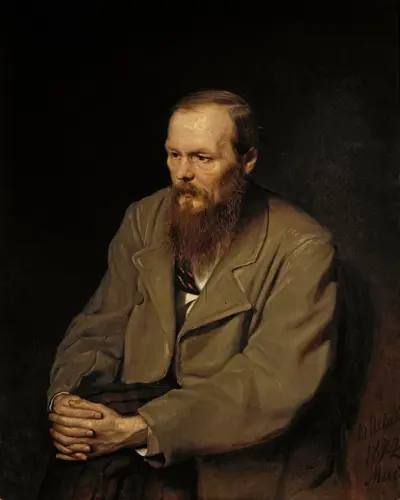
Fyodor Mikhailovich Dostoevsky, sometimes transliterated as Dostoyevsky, was a Russian novelist, philosopher, short story writer, essayist, and journalist. Dostoevsky's literary works explore human psychology in the troubled political, social, and spiritual atmospheres of 19th-century Russia, and engage with a variety of philosophical and religious themes. His most acclaimed works include Crime and Punishment (1866), The Idiot (1869), Demons (1872), and The Brothers Karamazov (1880). Dostoevsky's body of works consists of 12 novels, four novellas, 16 short stories, and numerous other works. Many literary critics rate him as one of the greatest psychological novelists in world literature. His 1864 novel Notes from Underground is considered to be one of the first works of existentialist literature.
