Newt Gingrich Quotes
In very rare circumstances, the executive branch might choose to ignore a court decision.
Gingrich, Newt. Bringing the Courts Back Under the Constitution. Newt 2012, 2011, p. 22.

In 1832 the Supreme Court held that the state of Georgia could not remove Creek and Cherokee Indians from lands that had been guaranteed to them by a federal treaty. The president disagreed with the court, then headed by John Marshall:. Marshall could not do so without the executive. The Indians were illegally removed to Western lands.


In general, Justice Jackson was correct. Almost all major Supreme Court decisions that have ruled against the Legislative Branch or the Executive Branch, have been, reversed by a future Supreme Court, reversed by new legislation, reversed by a subsequent Constitutional Amendment, reversed by science or technology, or acknowledged by future generations to be wrong but were now moot and needed no correcting. The greatest of the Supreme Court decisions have generally been those that upheld the Congress and the Executive.

Originally it was published in Boston under the name “A Columbian Patriot.”

Barstow the Democratic Governor who had no serious opposition in 1853 found himself challenged for reelection by Coles Bashford of the new Republican Party. The Board of Canvassers reported that Governor Barstow had won reelection but by less than 200 votes in the whole state. The Republicans charged that there had been fraud in some of the rural districts and petitioned the Wisconsin Supreme Court which ruled that nonexistent precincts had indeed voted for the Governor. The Barstow however refused to recognize the decisions of the court claiming that the court had no jurisdiction over the Board of Canvassers who were part of the executive branch. The Republicans held their own inauguration and two men claimed to be Governor. But the Governor claimed that the state constitution did not give the court any authority to deal with the crisis, He even called out the State Militia to maintain his office and intimidate the Supreme Court and keep the “other governor” from the state house. Nonetheless the court ruled that even the Governor had to obey the law and the Supreme Court would determine what the law was. Barstow finally “resigned.” See {587917} & {587914}.


In many nations, there is little judicial independence from the government. Judicial decisions that thwart government sometimes produce retaliation ranging from reducing the pay or staff of judges, threatened investigations and impeachment even arrest and execution---sometimes by government ‘death squads’. Even in the United States, the beginning of the 21st century, was fraught with so many examples of judicial intimidation threats, that two Supreme Court justices began speaking throughout the country to educate the public to this problem. In general, the more democratic and free a nation is, the more frequently the courts will disallow activities of the executive and even the legislature.


Referring to the Brown v. Board of Education, the Topeka, KS, Supreme Court school desegregation decision:


The view that the Supreme Court was the final arbiter of constitutional controversies was not held in early America.


Some of the Founding Fathers did not conceive of the kind of judiciary where Federal courts could nullify an act of the Congress by declaring a law unconstitutional. Morris was one. Others did. The Constitution is not very explicit on this point, but the nation has settled with a process that would have surprised Morris and a few others.
Judicial Review is the principle which allows a court—judges—to declare an act of the legislature or the executive improper and unlawful. It is a standard principle of American government yet it was not explicitly stated in the Constitution. Hence to some, there is a question about the legitimacy of Judicial Review itself. Many nations do not have it. Many people think it is the most important aspect of a democratic society as it provides a check on both the executive and the legislature.

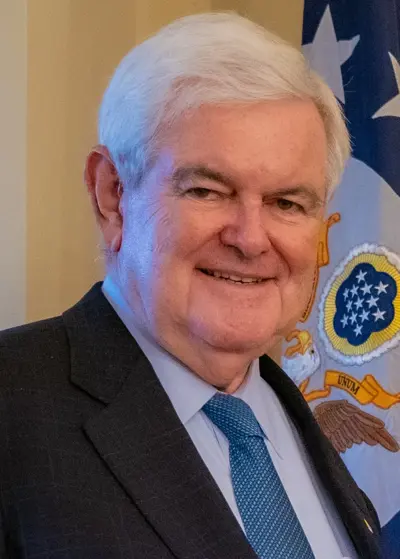
Newton Leroy Gingrich is an American politician and author who served as the 50th Speaker of the United States House of Representatives from 1995 to 1999. A member of the Republican Party, he was the U.S. Representative for Georgia's 6th congressional district serving north Atlanta and nearby areas from 1979 until his resignation in 1999. In 2012, Gingrich unsuccessfully ran for the Republican nomination for President of the United States.
