George F. Will Quotes
In the past four years, the U. S. sugar price has averaged between 64 and 92 percent higher than the world price, The costs are dispersed to hundreds of millions, The benefits accrue primarily to 4,700 sugar … farms.
George Will, Political Columnist, Senate Staff Assistant “How Sweet It Isn’t”, The Washington Post, June 9, 2013
Sourced by: Eigen's Political and Historical Quotations

The bills that Congress tends to pass provide benefits for very few but spread the costs over many of not the whole population. In the majority of concentrated benefits, the beneficiaries have made large campaign donations and/or have retained powerful lobbyists. They are special interests in the truest sense of the word. See {633225} for a good example of this principle.
Actually, the Agriculture Department was one of Lincoln’s greatest achievements. The subsidies and corporate welfare came much later. The biggest benefits were the land grant collages where agricultural research improved the yields and productivity and the Agricultural Extension provided training and technical assistance to American farmers making the United States the most efficient agricultural producer in the world. The subsidies and corporate welfare had and has nothing to do with the positive initiatives that Lincoln envisioned.


Herbert Hoover was then the Food Administrator and in part with his assistance, Congress passed The Food Control Law August, 1917 which contained a provision, guaranteeing a wheat price to the farmer of two dollars a bushel. This was the beginning of Agricultural Subsidies and Corporate welfare for the large farm companies. It was passed under the Democratic Wilson Administration but Republican Herbert Hoover was one of the major supporters.

America and several other nations object to the European Community agricultural subsidies in that they are an illegal trade practice under GATT to which all European nations are signatories. However, the US also makes agricultural subsidies but not to the same extent,
For many nations, it is an important objective to be totally self-sufficient in their food supply—so that they would not have to depend in other nations in what might be a world famine or food supply. For those nations agricultural subsidies are useful if their farmers cannot produce as cheaply and efficiently as other nations do. In the United States, with the most efficient agriculture in the world, subsidies are a waste of public money {633243} and the result of lobbying and special interest pressure and or corruption {633245}.


Despite developed nation calls for free trade, The US, EEC and Japan maintain an extensive system of agricultural subsidies which are politically difficult to eliminate while expecting developing nations to eliminate their protectionist practices.


She was then the European Commissioner for Competition.


1st Earl of Beaconsfield
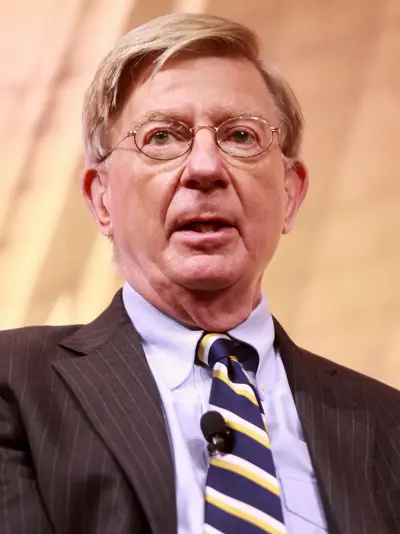
- Born: May 4, 1941
- Nationality: English
- Profession: Columnist, Journalist, Author
George Frederick Will is an American libertarian-conservative political commentator and author. He writes regular columns for The Washington Post and provides commentary for NBC News and MSNBC. In 1986, The Wall Street Journal called him "perhaps the most powerful journalist in America," in a league with Walter Lippmann (1889–1974). He won the Pulitzer Prize for Commentary in 1977.
