Dalia Mogahed Quotes
In comparing high conflict Moslems with the rest of the Moslem population, we find that the high conflict individuals attend mosque worship service far less.
“High conflict” is the euphemism that her center uses to describe Islamic terrorists as well as those who support their activities and positions.
Dalia Mogahed, Executive Director, Gallup Center for Muslim Studies, Threat of Global Terrorism, February 12, 2007
Sourced by: Eigen's Political and Historical Quotations


This sura is interpreted in two ways. For many modern Muslims it means that in discussions and debates on religion with non-Muslims, do not back off, and if you do it is a religious transgression. Defend the faith. For the fundamentalists and extremists, they interpret the same sura in physical warlike terms. So if there is a fight or battle with disbelievers, retreating from the battlefield is not only cowardice and perhaps a crime under military regulations as it is in the West, but it is in Christian terms a mortal sin for which there one will go to hell. So the most religious of Muslims will fight to the death using this sura as their guidance. On the other hand, Muhammad himself as the military and civil leader of Islam made strategic retreats. In the history of almost all warfare between the West and Muslims—especially the Arabs—courage on the battlefield has been lacking and the Israelis, British, French, Americans, and Hindus of India all observe this military weakness and accounting for this is built into their military doctrine.

This is one of the quotations from the Koran which many Islamic terrorists point to in order to morally justify terrorism. For an example, see {586965}.


Although the Muslim invasion converted many with force and coercion (conversion by the sword) and used rape to produce a generation of youngsters who could be brought up as Muslims, many Hindus preferred the now religion for the above reasons. In addition, for all but the highest cast Brahmins, the cast system made Indians ripe for conversion to a religion that preached equality of all Muslims as a fundamental tenet. Islam was a much more modern and egalitarian religion.


He controlled a Shiite political party with its own armed militia.


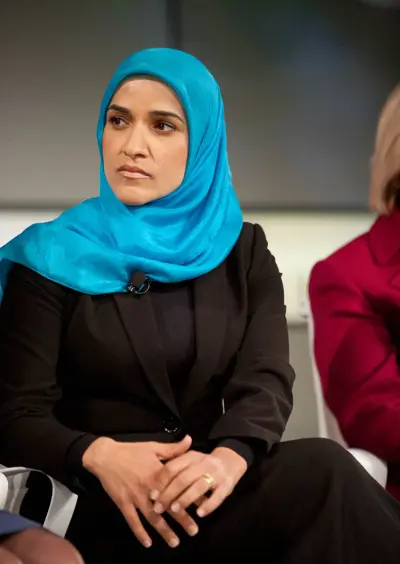
Dalia Mogahed (born 1975) is an American consultant of Egyptian origin. She is the Director of Research at the Institute for Social Policy and Understanding (ISPU) in Washington, D.C. She is also President and CEO of Mogahed Consulting, a Washington, D.C.-based executive coaching and consulting firm specializing in Muslim societies and the Middle East. Mogahed is former Executive Director of the Gallup Center for Muslim Studies, a non-partisan research center that provided data and analysis to reflect the views of Muslims all over the world. She was selected as an advisor by U.S. President Barack Obama on the White House Office of Faith-Based and Neighborhood Partnerships.
