Genghis Khan Quotes
If unable to abstain from drinking, a man may get drunk three times a month; if he does it more than three times he is culpable; if he gets drunk twice a month it is better; if once a month, this is still more laudable; and if one does not drink at all what can be better? But where can I find such a man? If such a man were found he would be worthy of the highest esteem.
Riasanovsky, V. A. Fundamental Principles of Mongol Law. Indiana University Publications, 1965, p. 83.


Aeneas Sylvius Piccolomini. Early in his career, as Secretary to the Emperor, he was assigned to oversee the education of the young king of Bohemia. Piccolomini’s advice of temperance was not at all based on theological reasons as drinking was rampant, even among the clergy. Also, he recognized the major effect of peer pressure on teenagers as it affects drinking behavior.


In 1931 prohibition was a major political issue. Mayor William Hale Thompson organized campaign parades complete with circus animals. A camel carried the following sign.

This pledge was taken by over half a million Americans in Mathew's 1849-1851 tour of the United States promoting the Teetotal Abstinence Society.


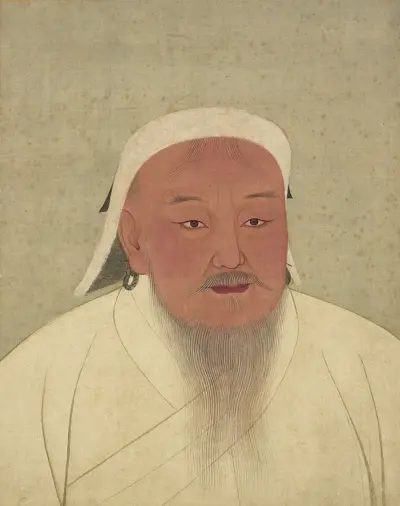
Genghis Khan, was the founder and first Great Khan (Emperor) of the Mongol Empire, which became the largest contiguous empire in history after his death. He came to power by uniting many of the nomadic tribes of Northeast Asia. After founding the Empire and being proclaimed Genghis Khan (an honorary title possibly derived from the Turkic "tengiz" — sea, meaning "the oceanic, universal ruler"), he launched the Mongol invasions that conquered most of Eurasia, reaching as far west as Poland in Europe and the Levant in the Middle East. Campaigns initiated in his lifetime include those against the Qara Khitai, Khwarezmia, and the Western Xia and Jin dynasties, and raids into Medieval Georgia, the Kievan Rus', and Volga Bulgaria. These campaigns were often accompanied by large-scale massacres of the civilian populations, especially in the Khwarazmian and Western Xia-controlled lands. Because of this brutality, which left millions dead, he is considered by many to have been a brutal ruler. By the end of his life, the Mongol Empire occupied a substantial portion of Central Asia and China. Due to his exceptional military successes, Genghis Khan is often considered to be one of the greatest conquerors of all time.
