Thurgood Marshall Quotes
... if the United States is indeed the great melting pot, the Negro either didn't get in the pot or he didn't get melted down.
Thurgood Marshall, 1909-1993, U. S. Supreme Court Justice, Newsweek, September 21, 1987
Sourced by: Eigen's Political and Historical Quotations

He even paraphrased it in one of his opinions.


Blacks were fighting and dying in WWII. They were equal when they were under fire, but otherwise not. The war was against fascist protagonists whose creed was inequality while the allies were upholding freedom and equality. But making that aspiration a reality was difficult.


This became one of the most widely quoted statements of the 1960s and 1970s.


Bilbo was one of the worst racists who ever served in the Congress.


The racial inequality did cause a Black revolution in the 1960s. The arrival and influence of Martin Luther King, at the time Black revolution might have turned violent, and the willingness of a substantial number of whites to implement the Civil Rights revolution functioned as a safety valve so that there was substantial reform towards much more racial equality.
Charleston was in the Southern part of the state where most people supported slavery. Douglas made an unequivocal pitch for the racist vote {600060} and forced Lincoln to take a stand. Like many politicians today, Lincoln decided to give the audience what they wanted to hear. It is not clear whether or not he ever believed this statement or was just pandering in a political campaign. He had never said this in the Northern part of the state of before. Lincoln’s views on race changed and matured over the years, culminating in the Emancipation Proclamation. Lincoln lost the Senate seat to Douglas.


In 1862 the president requested a $600,000 congressional appropriation to finance a pilot program for Negroes freed by the Civil War to emigrate to Africa. He met with a delegation of Black leaders:


Ames was not a native Southerner but as a General of the Union Army he had been the military commander of the wartime district of Arkansas and Mississippi where he became sufficiently popular to be elected Senator. However, once the segregationists returned to political power, Ames lost his bid for reelection amidst a massive, vicious campaign of intimidating Blacks from voting combined with local, rural corruption of the local balloting process. Ames also served as a general in the Spanish American War and was the last surviving Civil War general.
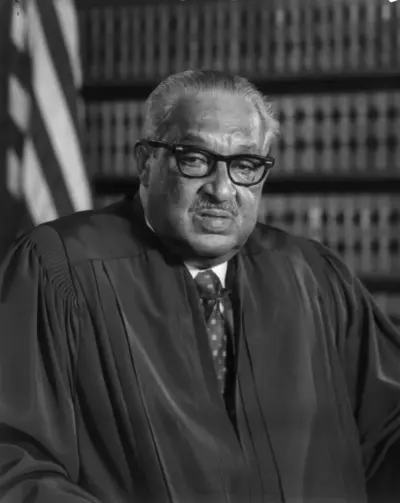
Thurgood Marshall was an American lawyer and civil rights activist who served as Associate Justice of the Supreme Court of the United States from October 1967 until October 1991. Marshall was the Court's first African-American justice. Prior to his judicial service, he successfully argued several cases before the Supreme Court, including Brown v. Board of Education.
