William Tecumseh Sherman Quotes
If secession were allowed, the U. S. Constitution would be a mere rope of sand that would break with the first pressure.
William Tecumseh Sherman, 1820-1891, General of the Army & Indian Peace Commissioner, 1861, Quoted in C-SPAN, The Meaning of the Civil War, May 3, 2014
Sourced by: Eigen's Political and Historical Quotations

President John Adams Alien and Sedition Acts were amongst the worst laws ever passed in America. It totally violated the First Amendment but at the time the Supreme Court had not ruled on the laws which prohibited criticizing the government. Ironically, it was Adams’s son, John Quincy Adams who finally led the repeal effort.


Fortunately he was wrong, but the threat of a breakup of the American Union intimidated most members of Congress to avoid anything that would offend a state or group of states. Thus slavery became more and more entrenched till it exploded into the Civil War. At the time the issues of contention included the fact that Louisiana was primarily Roman Catholic and ALL other states were majority Protestant. The territory functioned under French Law—the Napoleonic Code, while all the other states operated under the English Common Law (even today this is so), and there was concern with the French and Creole language and whether the Creoles would fit into American Culture.


In the related quote, Jackson makes the case against the South Carolina argument for nullification. Here he makes his threat which was very successful in ending the notion of “nullification”. The extensive quotation is given as it summarizes the entire issue that was one of the crises of early America.

This is an important quotation because it shows that slavery was the principle reason that the South succeeded and began their rebellion. In the early 20th century, there was a movement to make the Confederacy and the rebellion more noble by promoting the idea that the Civil War was fought by the South for more lofty reasons such as States Rights, Original Construction, different economic philosophies and the like. This was a more noble cause then the right to deny other human beings their rights, to own other human beings who they could beat, torture, sexually use and even murder them was a pretty selfish and demeaning reason to have started a rebellion that would then cost more Americans their lives than any other American conflict. The succession documents and others of the Southern States and the Confederacy make it clear that slavery was THE issue and fleeting references to any of the others were only made to complain about the potential effect on abolition and the refusal of the abolitionist states to cease aiding and protecting fugitive slaves.


Mason’s view prevailed. What is interesting is that Mason saw the State as the State Legislature as opposed to the people of the state directly voting for the Senators as we do today.

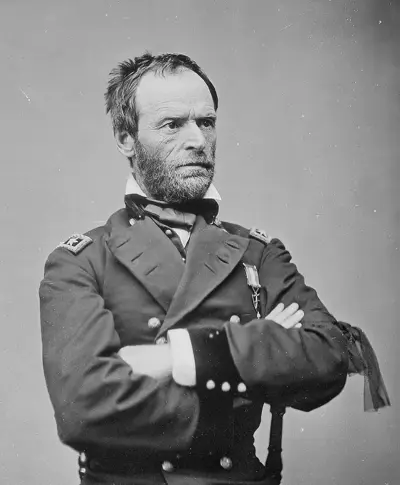
William Tecumseh Sherman was an American soldier, businessman, educator, and author. He served as a general in the Union Army during the American Civil War (1861–1865), receiving recognition for his command of military strategy as well as criticism for the harshness of the scorched earth policies he implemented in conducting total war against the Confederate States. British military theorist and historian B. H. Liddell Hart declared that Sherman was "the first modern general".
