Adam Smith Quotes
If a foreign country can supply us with a commodity cheaper than we ourselves can make it, better buy it of them with some part of the produce of our own industry, employed in a way in which we have some advantage.
Adam Smith, 1723-1790, Scottish Political Economist, The Wealth of Nations
Sourced by: Eigen's Political and Historical Quotations


This is one of the earliest enumerations of the methods by which nations might rectify an imbalance of trade.


Turgot was one of the most advanced economic thinkers in Europe and realized, even before most of the Americans, that by freeing itself England, that the Americans would be forced to become free traders and that in turn would make America a major Economic power despite the fact that American economic policy over the years vacillated between protectionism and free trade.

A response to Richard Deason (a union official) when he challenged Milton on his proposal to eliminate tariffs over five years.


The nation, under the pressure of a depression, had adopted a free trade philosophy. We would go back to protectionism in the 1930s and back to free trade in the 1960s. Ironically, it was generally the Republican party that has driven these shifts. There has always been a free trade wing of the party and an isolationist wing.


It is very easy for an American company to make parts in the United States, ship them to Mexico for assembly and bring the finished product back. However, for counties like France it is much more difficult.

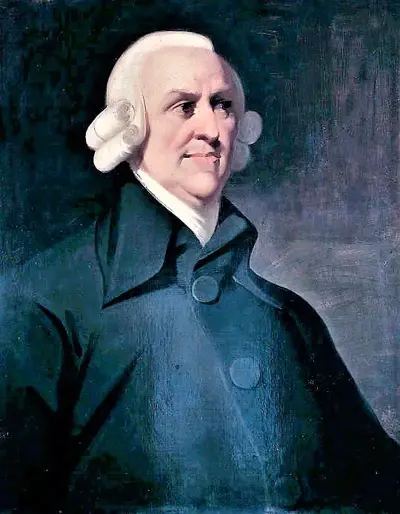
Adam Smith FRSA was a Scottish economist, philosopher as well as a moral philosopher, a pioneer of political economy, and a key figure during the Scottish Enlightenment, also known as ''The Father of Economics'' or ''The Father of Capitalism''. Smith wrote two classic works, The Theory of Moral Sentiments (1759) and An Inquiry into the Nature and Causes of the Wealth of Nations (1776). The latter, often abbreviated as The Wealth of Nations, is considered his magnum opus and the first modern work of economics. In his work, Adam Smith introduced his theory of absolute advantage.
