Oriana Fallaci Quotes
I was a little girl fighting as a partisan against Nazi-Fascism.
Fallaci, Oriana. The Rage and the Pride. Rizzoli International, 2002, p. 14.


German-Americans were split before the war into pro and anti-Nazi factions.


Many hard line communists were very angry with this directive. The Italian communists were major leaders of the anti-Fascism movement and were better armed and organized than other anti-Fascists. They thought that this was a good opportunity, under the guise of anti-fascism to gain control all the other political forces in Italy. Togliatti, in contrast, strove for a national unity movement overthrow the fascist government of Italy without massive death and casualties. His choice of an effort of anti-fascist unity, made the transition relatively bloodless, and was not forgotten by the non-communist, non-fascist Italian politicians. After communism was banned in many of the other Western European governments, Italian political leaders allowed the Communists to be a part of the political system, and while the communists have never been popular enough to form a government, they have been a part of Italian politics ever since.

Shortly after the failed uprising the Mufti went to Berlin where he was made a Nazi SS Major General and set up Arab SS Units to exterminate the Jews in the Middle East. See {586894}.

The Nazis occupied the cities, but the partisans survived in the mountains. The resistance was ferocious and very effective. From a German Soldier’s point of view, the Yugoslav front was the most dangerous assignment where his odds of being killed was even greater than the Russian front.

The Germans had invaded much of Russia, and this was a month before Pearl Harbor so the Russians had no idea that the United States would actively enter the war although they were getting war material help from America.

The man who was “the best war photographer in the world” but was a refugee from Hungary in New York. The Government actually prohibited him from having a camera and would not give him a visa to go to Europe to cover the War. Finally the government relented from its absurd concept of security and Capa became the leading photographer of the American Army effort in Europe and shot the greatest photos of the D-Day landing. Incredibly, in the McCarthy era, his passport was rescinded by the State Department because he had photographed the Spanish Civil War and was wrongly thought a communist. After legal action he got his passport back and covered Vietnam. While with front-line American troops he was blown up by a mine, the first American journalist killed in the Vietnam war. And the man who the State Department thought disloyal in three wars, was given a military funeral in Vietnam and his family was offered burial in Arlington National Cemetery reserved for American military.

This speech was given in the early days of WWII when it was far from clear that we would win.


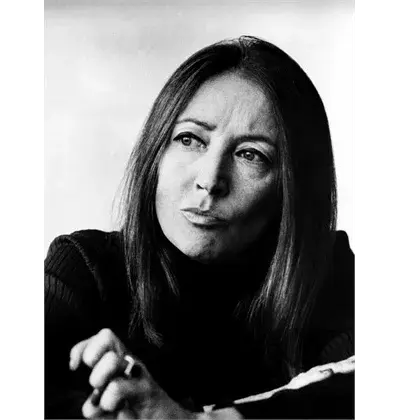
Oriana Fallaci was an Italian journalist, author, and political interviewer. A partisan during World War II, she had a long and successful journalistic career. Fallaci became famous worldwide for her coverage of war and revolution, and her "long, aggressive and revealing interviews" with many world leaders during the 1960s, 1970s, and 1980s.
