Kofi Annan Quotes
I think that my darkest moment was the Iraq war and the fact that we could not stop it.
Annan, Kofi. Interview by Jonathan Freedland. The Guardian, 31 Aug. 2012.


The George W. Bush Administration told Congress and the people of the world that Iraq had developed weapons of mass destruction and were about to deploy them. We invaded Iraq and it turned out that there were no WMD’s in Iraq. No one knows if the all in the administration honestly believed the intelligence, how many doubted it, and how many others suppressed contradictory evidence of which there was much. Some members of the administration wanted an invasion of Iraq for other reasons, personal and economic.

In 1936, Fascist Italy invaded Ethiopia in an effort to obtain an African colony like other European Countries had. Over 50 nations had promised aid to Ethiopia if attacked but then the Italian attacks came, it was not just soldiers with some small artillery and vehicles. Instead it was a full modern army with not only heavy artillery and tanks, but extensive use of air power against villages and towns which generally hardly had rifles. The airplane carnage of civilian populations was a shock to the world. However, the tactics were studied by the Italian German Fascist allies who further developed air power use against unarmed towns and cities in the Spanish Civil war. The aid promised to Christian Ethiopia never materialized because there was a worldwide depression and the great powers would have had to commit to major war—not just send some arms and ammunition. The Ethiopians mostly fought with spears and knives. The Fascists were thus emboldened for the invasion of Europe a few years later.


Hoover and most Republicans were generally opposed to sanctions and an instrument of foreign policy. 25 years after his presidency, the Republican Party started embracing sanctions as a tool of foreign policy and by the end of the 20th century, Republicans were sanction hawks. This quotation illustrates how American political parties and their philosophies change over time.


In every major war in the United States there have been government activities contrary to law, most of which were embarrassments when discovered years later and in retrospect most of which did not help the war effort in any way but undermined the sense of law and order either by not enforcing certain laws (profiteering in WWI or violence against war protesters in the Vietnam War), passing new laws that in retrospect were unjust or unconstitutional (incarceration of Japanese Americans in WWII) or by engaging in illegal activities (illegal spying and detention in the Iraq War.)

Mahathir, in his moral assessment, fails to come to grips with the fact that the Coalition forces in their Afghan and Iraq activities attempt to kill and injure as few people as possible to accomplish their objective. The terrorists attempt to kill and injure as many people as possible. In the September 11 attack, the buildings could have been attacked late at night so there would be few casualties, and in Bali they could have bombed the facility after it had closed instead of waiting until there was the largest audience. And the terrorist bombs include nails, rat poison, and other additional material designed not to do more building damage, but to kill and maim more people which is their specific objective. Most wars have collateral damage and the parties are required to make a good faith attempt to minimize that. But the terrorists not only make no attempt, but make strong efforts to kill as many as possible. That is a huge moral and ethical distinction.
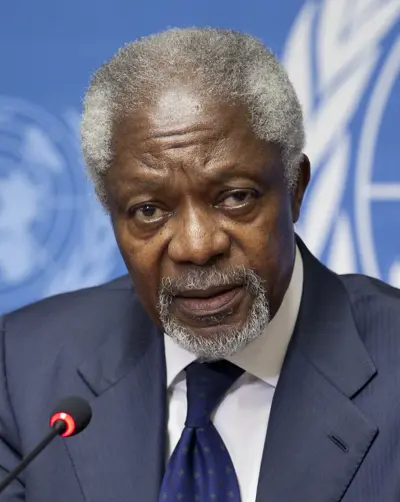
Kofi Atta Annan was a Ghanaian diplomat who served as the seventh Secretary-General of the United Nations from January 1997 to December 2006. Annan and the UN were the co-recipients of the 2001 Nobel Peace Prize. He was the founder and chairman of the Kofi Annan Foundation, as well as chairman of The Elders, an international organization founded by Nelson Mandela.
