Matthew Whitaker Quotes
I think our founding fathers believed in nullification. There's no doubt about that.
Whitaker, Matthew. Interview. Caffeinated Thoughts Radio, KTIA, 2014.


Commonly referred to as the Kentucky Resolution. This concept of Nullification was one of the factors that aggravated the tensions leading to the Civil War. Were the individual States to be the arbiters of whether or not a Federal act was Constitutional or was it to be the Supreme Court.


at the NSA collection of every American’s private e-mails, phone calls, and other digital communications. Referring to the NSA program of collecting information on all electronic communications of all American Citizens. See {636963} for more on the case.


Soon after Jackson's reelection, delegates from South Carolina, led by John C. Calhoun, moved quickly to declare "null, void, and no law" the Tariff Act of 1832. The president's reaction to the Ordinance of Nullification was swift.

There are some Americans who believe that the courts should look to the original intent of the framers of the Constitution to determine the constitutionality of a law. Most jurists believe that original intent is but one factor that should influence the decision.

The 10th Amendment reserves powers to the states and limits the Federal Government’s powers. However, there are other clauses in the Constitution, like the Commerce Clause (Article I Section 8), which gives the Federal Government authority and control over Interstate Commerce, which in modern society permeates almost all activities of State government, The result is that the federal government / state government power division has been a political issue and not really a constitutional one. At the time Republicans advocated a literal 10th Amendment interpretation and the Democrats favored a stronger Federal Government with more authority and power as stated by the Commerce Clause. Roy had been trying to explain to his fellow Republican strategists that it is hard to attract Blacks to the remainder to the Republican Platform as long as they were insensitive to what the 10th Amendment meant to Blacks historically. The Southern states cited the 10th Amendment more than any other part of the constitution to justify their right to maintain slavery. It was the Federal Government that ended slavery. Under the rubric of the 10th Amendment the South managed to get rid of most of the racial civil rights Reconstruction reforms that were imposed by the Federal Government on the Southern States. And it was the 19th Amendment that was the authority for Segregation for 100 years. And the terrorism of the Klu Klux Klan and the lynching and terror imposed on Blacks by Southern states claiming the 10th Amendment right to do so. Finally, it was the Federal Government, overriding the 10th Amendment with the Commerce Clause and other parts of the Constitution that passed and enforced the Civil Rights Act, the Voting Rights Act, Desegregation and the end to Lynching and other Southern State-Sponsored terrorism. Blacks will not any time soon accede to having the 10th Amendment literal view of the role of government and if Republicans insist on that there would continue to be very few Black Republicans,


She was always an American optimist. Most of the Southern States did everything possible to try and defy the Supreme Court’s decisions on school segregation and other matters regarding their “traditional rights” to discriminate racially. Entire public school systems closed rather than desegregate. The Civil Rights Act and Voting Rights Act in 1964 made it much more difficult, But change took place inexorably over the next years as the older generation gave way to the new—one that was more educated and better informed as a result of television. Mississippi had more Black elected public officials than white. By the 21st century, there were relatively few areas where the Southern States still tried to evade the Supreme Court.
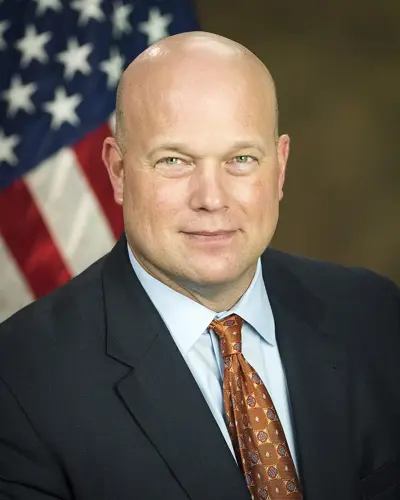
Matthew George Whitaker is an American lawyer, lobbyist and politician who served as the acting United States Attorney General from November 7, 2018, to February 14, 2019. He was appointed to that position by President Donald Trump after Jeff Sessions resigned at Trump's request. Whitaker had previously served as Chief of Staff to Sessions from October 2017 to November 2018.
