Eddie Campbell Quotes
I remember having an argument with Alan, I said the Queen's not just going to call the guy up and send him out to do it. And Alan says, well, how would a monarch give orders to her assassin.
Campbell, Eddie. Interview by David Carroll. Tabula Rasa, no. 6, 1995.

She was Queen of Scotland and claimed the English throne as well. While Elizabeth I was on the throne of England, Mary claimed that the court had no jurisdiction over an absolute monarch. Her son was in France at the time but eventually succeeded to the Scottish throne as James VI and the English throne as James I.

This is the most formalized and sophisticated compendium of laws of the so-called “barbaric peoples” of Europe. The compilation was in many ways a documentation of the traditional laws of the Visigoths that had evolved over hundreds of years.


This testimony turned out to be a tactical error. The main purpose of Tojo was to protect Emperor Hirohito from responsibility for the war. See {587277}. But by admitting that he never disobeyed even the Emperor’s wishes, he made it clear that he had implemented the Emperor’s desired policies. Therefore, Hirohito must have been responsible. After this testimony there was some delay and he changed his testimony claiming that once he disobeyed the Emperor when he took the nation to war. Few believed this second version, but it was sufficient to keep Hirohito from being charged—which despite many calls for his trial, General MacArthur also did not want the Emperor brought to account as the institution was making the occupation of Japan very easy.

“Somsteu” was the name the Africans gave to Theophilus Shepstone, 1817-1893, British Colonial African Administrator.

William the Conqueror. See Henry of Huntington for another similar description of the King's authority.


This was written shortly before he assumed the crown.
This phrase was used on all royal decrees and it accurately reflected the Bourbons “divine right” to rule


Prior to Cooke’s indictment of English King Charles I, there was a concept of Royal Impunity—that a sovereign could not legally be called to account for his actions as ruler of the state. The concept of “sovereign immunity” was a concept where the sovereign and his agents could be given immunity for specific actions, but they never would have impunity again where there were no limits to the crimes they might commit against their own people. Charles I refused to even recognize Cooke’s indictment and so have heads of state called to account for their major crimes since then all the way down to Saddam Hussein in 2006 who made the same argument. Cooke was himself hanged, drawn and quartered almost 20 years after the Charles I trial for his part in the “Regicide” so the concept of Royal Impunity did not die quickly.


This quotation reflects the Spinoza view that the individual is supreme in determining truth.

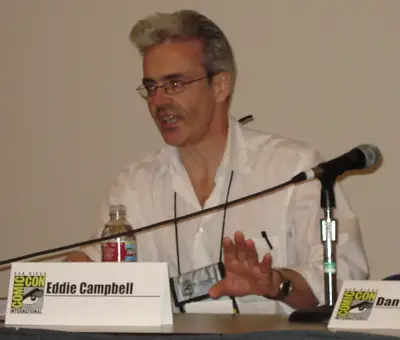
Eddie Campbell is a British comics artist and cartoonist who now lives in Chicago. Probably best known as the illustrator and publisher of From Hell (written by Alan Moore), Campbell is also the creator of the semi-autobiographical Alec stories collected in Alec: The Years Have Pants, and Bacchus (a.k.a. Deadface), a wry adventure series about the few Greek gods who have survived to the present day.
