Charles Darwin Quotes
I never saw any of the diminutive Portuguese [slave masters], with their murderous countenances, without almost wishing for Brazil to follow the example of Haiti; and, considering the enormous healthy-looking black population, it will be wonderful if, at some future day, it does not take place.
Darwin was then a very young man, who had personal witnessed the slavery in South America and the Caribbean when he was on his famous expedition on HMS Beagle. See {630961} & {630962}. He was so disgusted with slavery that he hoped there would be armed slave revolutions and takeovers as had occurred in Haiti. Many of the English upper classes were radical when it came to slavery.
Charles Darwin, 1809-1882, English Scientist, Letter to J. S. Henslow, March 1834
Sourced by: Eigen's Political and Historical Quotations

Pernambuco is a state of Brazil. His voyage took him to several slave countries.
His voyage took him to several slave countries where his anti-slavery views were challenged by locals.


This prophecy written in the later years of Jefferson’s life turned out to be all too true. St. Domingo was an Island in the Caribbean where slavery produced a bloody war. The American Civil War would be far worse.


During the 1830’s the debate over whether the British Empire should abolish slavery was revived and caused much unrest, It illustrates the total incompatibility between slavery and literacy & education.

As an entertainer she had toured much of the world and seen American slavery and that of some other nations. She became a staunch abolitionist and like entertainers in the 20th and 21st centuries she used her celebrity to give anti-slavery lectures and perform for audiences where she donated the proceeds of the event to the abolition cause. She is a particularly interesting political figure in that she seems to be one of the first entertainers to perform for a social cause and become an activist.

She was one of the early abolitionists. Despite the Southern attempted repression of information of slave resistance, some of the facts emerged and were well known in the North. The South tried to suppress these incidents lest other slaves get ideas from it. Also the Southerners often maintained that Africa was so primitive and underdeveloped, that the slaves were better off in America; these actions of rebellion belied this notion.

He stated that he had a vision and made these two prophesies that indeed came true. The first was the South Carolina secession starting the Civil War. The second, when the North used former slaves as soldiers who fought their old masters.


There indeed were although the Southerners tended to exaggerate the numbers. However, the more slavery was debated, the more many of the abolitionists came to believe that insurrection and slave rebellion was not only morally justified but was the only recourse that was left by the racist intransigence of the Southern slave holders and politicians.
American reformers followed slavery issues in Africa and elsewhere. The status of Africa was particularly important as the notion of extensive American Black colonization was still viable to many.

Ireland, a part of the British Empire, and ruled by the English monarch, had many who celebrated the French Revolution, even as the English Royalists, looked upon France in horror. What is interesting is that the Irish newspaper could actually publish opinions like this which could be argued were treasonous.

His fear was well founded. That is exactly what the British tried to do.


Most people do not realize that the best economic argument for retaining American slavery was made by the Father of Communism himself. What Marx did not realize was how rapidly the Northern States were industrializing and how much science and technology was bushing society ahead economically. However, 15 years later, when slaves began to be emancipated, the world had changed again, and the North thrived economically and every other way without the “contribution” of the products of Southern slavery. It may have been however that in 1848, America could not have fared so well without slavery, but 1861 was a different economic era.


The last lines of the editorial were tragically accurate in predicting the Civil War. The more the slavery question was debated in the nation, the more polarized the country became. If the South would persist in trying to curtail men’s freedom and maintain slavery, the slaves had the same right of revolution and insurrection as was established in the American Revolution. That was the view of most abolitionists. Southern slave holders, feared an armed slave rebellion more than anything else, and observed that debating the issue of slavery was just riling up Blacks and whites and would instigate such armed revolutions. The Southern solution was to cease debating the slavery question. The Northern solution was to end slavery. Neither side would accept the solution of the other and the Civil War ensued.

This is an important quotation because it shows that slavery was the principle reason that the South succeeded and began their rebellion. In the early 20th century, there was a movement to make the Confederacy and the rebellion more noble by promoting the idea that the Civil War was fought by the South for more lofty reasons such as States Rights, Original Construction, different economic philosophies and the like. This was a more noble cause then the right to deny other human beings their rights, to own other human beings who they could beat, torture, sexually use and even murder them was a pretty selfish and demeaning reason to have started a rebellion that would then cost more Americans their lives than any other American conflict. The succession documents and others of the Southern States and the Confederacy make it clear that slavery was THE issue and fleeting references to any of the others were only made to complain about the potential effect on abolition and the refusal of the abolitionist states to cease aiding and protecting fugitive slaves.

This fear was great among many who were abolitionists as potentially there might be mass slaughter of all Southern whites.
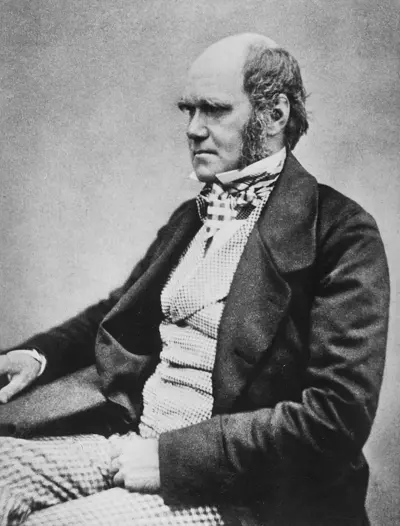
- Born: February 12, 1809
- Died: April 19, 1882
- Nationality: English
- Profession: Scientist
Charles Robert Darwin FRS FRGS FLS FZS was an English naturalist, geologist and biologist, best known for his contributions to the science of evolution.[I] His proposition that all species of life have descended over time from common ancestors is now widely accepted, and considered a foundational concept in science. In a joint publication with Alfred Russel Wallace, he introduced his scientific theory that this branching pattern of evolution resulted from a process that he called natural selection, in which the struggle for existence has a similar effect to the artificial selection involved in selective breeding. Darwin has been described as one of the most influential figures in human history, and he was honoured by burial in Westminster Abbey.
