Winston Churchill Quotes
I must confess, sir, I held you in very low regard. I loathed your taking the place of Franklin Roosevelt. I misjudged you badly. Since that time, you more than any other man, have saved Western civilization.
Winston Churchill, 1874-1965, British Prime Minister (Conservative), Statement to Harry S Truman, January 5, 1952
Sourced by: Eigen's Political and Historical Quotations


The Gallup poll at the time showed that 85% of the American public favored use of the atomic bomb.

Harriman was sent to Tokyo to meet with the general.

Truman told Kennedy to keep quiet or he would "throw him out the window." Truman was about to physically attack Kennedy he was so angry. Kennedy was a Nazi sympathizer and an admirer of Mussolini and Hitler and this ended his active political career. His oldest son Joe was his favorite, but Joe did not share his father’s fascist inclinations. He not only enlisted for service in WWII but he volunteered for a very risky secret mission on which he was killed. Kennedy blamed Roosevelt for assisting England (he had been the ambassador was pro Hitler and had urged against American involvement) and hence the war. Kennedy’s oldest son Joe, had enlisted to fight Germany. He was a pilot who had volunteered for a very dangerous secret mission in which his plane blew up and he was killed. Joseph Kennedy blamed Roosevelt personally for the death of Joe. Driven out of active politics, Kennedy used his wealth to promote his second son’s political career, and JFK and his brothers had managed thereafter to be politicians in the mold of Franklin D. Roosevelt and reject their father’s political philosophy. To this day, most Americans have no idea that the elder Kennedy held such positions.


The Korean War armistice left a vulnerable border between North and South Korea and approximately 40,000 American troops were necessary for decades thereafter to protect the border.

The then Attorney General had established a back channel to the Russian agent. There was genuine fear by the Russians and some in America that there were still many Nazis and German nationalists who would try and influence, if not take over, German politics to produce another aggressive German fascist state. The Russians had lost 22 million citizens to the Germans in the war and had faced a defeated Germany where virtually every German over the age of 30 had been cheering for and supporting Hitler a decade ago. Neither the Russians nor we and the other allies had not yet seen the remarkable turn-around that the German nation would make and the intense anti-fascist, non-military ethos that would be brought by the younger German generations. The direction of Germany was then very unpredictable.


Roosevelt had withdrawn his Ambassador to Berlin, publicly reprimanded Joseph P. Kennedy, his Ambassador to England who was pro Fascist and who had said complementary things about Hitler and Mussolini. FDR made anti-German statements to a degree unknown for a country not at war. Hitler publically stated that the Germans would not be pressured. Dictators who U. S. leaders have tried to isolate and pressure, have made similar statements ever since. The American intervention was certainly effective against Hitler.

De Gaulle himself was a very difficult egomaniacal (personally and nationally) man. Roosevelt was one of the few leaders who could handle De Gaulle, although even he admitted the difficulty.
The Prime Minister was visiting the United States and was staying at the White House. President Roosevelt had a spontaneous thought and wheeled himself into Churchill's room. The Prime Minister was stark naked, having just emerged from the bath. Roosevelt apologized but Churchill was unfazed and known for his nudity in his private quarters. He even used what might have been an awkward moment into an opportunity to make a political point.

The only soldier ever so honored. Marshall was then Chief of Staff of the Army. This quotation is historically very important in that it refutes the accusation made by some FDR and New Deal enemies that Roosevelt was very naïve about the importance of capturing Berlin and ceded control over the invasion and capture of Berlin to Stalin and the Soviet Union. Marshall, one of the most upright of politicians in American history, was not a FDR apologist and few doubted his word or judgment. (Senator Joseph McCarthy and other right wingers however falsely accused him of harboring communists in the Army and working against America’s interest against Russia.

Lindbergh, a great aviator, was a Fascist who was a great admirer and supporter of Hitler and Mussolini. By this time, even Lindbergh had seen much of the German aggression, and his opposition to the war was on the pragmatic ground that we could not win. He thought that democracy was too unsuited to a country being a major power.


Kennedy hated Roosevelt who had forced him to resign as the U. S. Ambassador to England. Kennedy was an admirer of Mussolini and Hitler. He had allied himself with the part of the British aristocracy that was pro Fascist and opposed Winston Churchill and the democratic element in Britain. Kennedy had opposed aid to Britain to fight Hitler and advised all who would listen that Britain could and would not stand up to Germany. Roosevelt’s support of Britain with Lend Lease and other means proved Kennedy wrong pragmatically and Kennedy’s own statements had forever proved him wrong morally. Although Kennedy opposed our entry in WWII, his sons did not. His oldest son volunteered for a very dangerous mission and was killed. Kennedy blamed his death on Roosevelt {616651} and forever after slandered FDR whenever he got a chance until his son Jack got into politics when his ambition for his son outweighed his hatred.
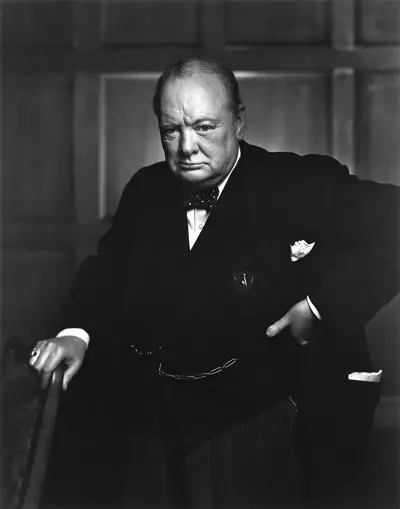
Sir Winston Leonard Spencer Churchill, KG, OM, CH, TD, DL, FRS, RA was the Prime Minister of the United Kingdom from 1940 to 1945, during the Second World War, and again from 1951 to 1955. Apart from two years between 1922 and 1924, Churchill was a Member of Parliament (MP) from 1900 to 1964 and represented a total of five constituencies. Ideologically an economic liberal and imperialist, he was for most of his career a member of the Conservative Party, as leader from 1940 to 1955. He was a member of the Liberal Party from 1904 to 1924. Churchill was also well known for his military career and as a historian, painter and writer, and among his many awards was the Nobel Prize in Literature.
