Harald I Quotes
I make the solemn vow, and take God to witness, who made me and rules over all things, that never shall I clip or comb my hair until I have subdued the whole of Norway, … or if not, have died in the attempt
Thus was Norway formed into a single kingdom. He married another woman, Asa, and several years later after he had unified Norway, Gyda too became his wife.
Harald I, c. 850-933, [Harold Fairhair], King of Norway, Oath he swore when Gydathe woman he wished to marry rejected him having thought him too petty a king only ruling over a few districts much like a modern warlord, c. 865
Sourced by: Eigen's Political and Historical Quotations


Al-Hakam’s reign was particularly bloody during which he beheaded thousands of dissidents. The son developed a nervous tic said to be the result of watching all the bloody executions.

He persuaded many other rulers to join the Indian Union when India became Independent.

Jinnah had whipped up his followers to violence so that Muslims were attacking Sikh and Hindu neighborhoods, burning them and murdering many occupants in different parts of India to intimidate the Indian Governmental Ruling Congress Party, The British Colonial Indian officials and the politicians in London to create a Muslim state—Pakistan—with all the territory that they demanded. Many Muslims were in turn killed in retaliatory attacks. The American diplomats and most English politicians tried to persuade Jinnah to compromise on the division of land and resources. Jinnah saw no reason at the time for compromise. However the internecine violence became so brutal and extensive that even Jinnah was shocked. The British would not be intimidated nor would the Indian Congress party and Jinnah was forced to compromise. Even with that, there were over 2 million Indians killed by the time the partition was complete. Jinnah and most other leaders were not willing to die themselves, but they were able to convince enough of their coreligionists to die.


Liberia was founded by American free Negroes who emigrated. From the beginning there has been a tension between the American founders and their decedents and the indigenous tribes. King, who had just been elected President, was trying to balance the interests and values.

He always appeared in a military uniform after that.


The Emperor had made his brother King of Holland, thinking of it as an unimportant backwater of the French Empire. But Louis took his oath and job very seriously, and although he did not have the great talent of his brother, he made a serious effort to be a good king.

In 1848 a number of revolutions flared throughout Europe with a call for democracy rather than monarchy. The Prussian king was one of those who really believed that he was selected by God to rule, was very frightened and tried to enlist the Queen and England to present a united front against the revolutionaries. England, which had already had a strong functioning parliament and extensive voting suffrage, protected most of the rights of its citizens and was a Constitutional Monarchy where there were limits to the power of the monarch. Further, Victoria was extremely popular and in many ways was far ahead of the electorate in terms of modern democratic reforms. So she was not in the panic of many of the other crowned heads of Europe were in. Somewhat following the example of England, King William IV allowed a parliament and minimized the strong military role that characterized Prussia. Most of the 1848 revolutions failed to sieze governments but, as with Prussia, forced reforms in what was a long movement to European democracy that would take another 150 years. Note also the logic about religion. Since the revolutionists did not believe in the divine right of kings, they opposed God’s will on earth. Therefore, they opposed God and must be atheists. Almost all counter revolutionary accusations included the claim—often not true—that the revolutionaries were atheists.
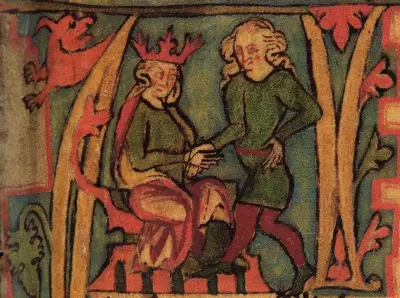
Harald I Fairhair (Old Norse: Haraldr inn hárfagri; Norwegian: Harald hårfagre; putatively c. 850 – c. 932) is portrayed by medieval Norwegian historians as the first King of Norway. According to traditions current in Norway and Iceland in the twelfth and thirteenth centuries, he reigned from c. 872 to 930. Supposedly, two of his sons, Eric Bloodaxe and Haakon the Good, succeeded Harald to become kings after his death.
