George Armstrong Custer Quotes
Gold has been found in paying quantities.
The discovery started a white frenzy to prospect the Black Hills. The trouble was that the 1868 Treaty of Fort Laramie had guaranteed the Black Hills to the Lakota Sioux. The Army tried to keep the white gold seekers out, but it was too difficult and there was not great public support for honoring the treaty. So the army decided to buy the Black Hills from the Indians and open it to legal prospecting. But the Sioux refused to sell not wanting to trade their sacred land for money and having no interest in gold. So the whites broke the treaty and took the gold anyway. This led to the hostilities and the greatest Indian victory wiping out Custer and his men at the Battle of the Little Big Horn.
George Armstrong Custer, 1839-1876, Major General, U. S. Army, Dispatch from the Black Hills to his superiors, 1874
Sourced by: Eigen's Political and Historical Quotations

Gold had been discovered in the Black Hills lands that were sacred to the Lakota Sioux and were reserved for exclusive use of the Indians by the Fort Laramie Treaty. Greedy whites, ignoring the treaty provisions not only entered the Black Hills to pan and mine for the gold, but killed many Indians they ran across Sherman was angry and wrote to his old friend President Grant. Grant, now a political, had to contend with public opinion that thought it absurd that gold should not be mined because a few Indians regarded the land as sacred. Meanwhile Grant was working with a few others to portray minor clashes between whites and Indians in the Black Hills as violent and dangerous Indians breaking the treaty.

Prior, the Military, worked hard to enforce the Fort Laramie Treaty which gave the Lakota Sioux Indian Tribe exclusive use of the Black Hills. Bu then gold was accidentally found in the Black Hills and white miners started to illegally enter the Lakota territory. Many of them killed Indians that they ran across. See Quotation 643700. President Grant, under huge political pressure instructed General Sheridan to stop enforcing the provisions of the treaty and keep the whites out of the Black Hills. They idea was to allow the miners to clash with the Lakota who would likely defend their sacred land, and when some whites had been killed, send the army in to “pacify” the Indians and use that as a means of relegation of the Treaty so the the gold areas would bee legally accessible.


His Indian Removal Policy forced Native American to leave their lands which were theirs by treaties signed by the United States and marched to the poorest land in Oklahoma where they were "resettled". This is often referred to as the "Trail of Tears". What made his actions evern wors was the fact that The Supreme Court had already ruled that such land belinged to the Cherokee Indian Tribe and the government of the United States may not force them from it. Jackson was the only President in Amrican History to defy a Supreme Court order.


This was the first Eastern Report of what was to become the “California Gold Rush.” The story was not thought important enough for the first page.


The meeting included several Indians, President Grant, and the Secretary of the Interior and the Director of the Bureau of Indian Affairs. The Indians had been offered $25,000 and land in the Oklahoma Indian Territory in exchange for moving from their traditional lands.
The Indians did not have the wheel when the whites came, but soon there were wagons, stage coaches and railroads.

Samuel Langhorne Clemens, 1835-1910


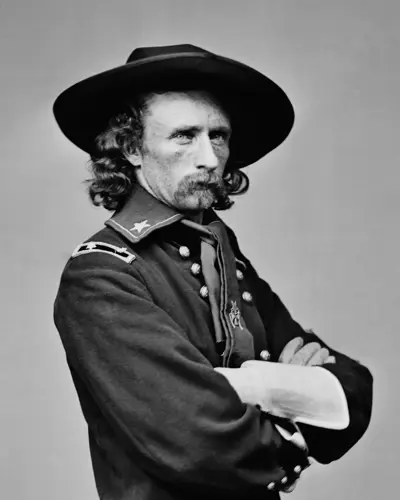
George Armstrong Custer was a United States Army officer and cavalry commander in the American Civil War and the American Indian Wars.
