J. D. Vance Quotes
For complicated historical and political reasons, we associate 'poor' in our public consciousness with 'black.' Terms such as 'welfare queen' and 'culture of poverty' became associated uniquely with the social maladies of African Americans in urban ghettos, despite the fact that poor whites outnumbered poor blacks.
Vance, J. D. Hillbilly Elegy: A Memoir of a Family and Culture in Crisis. Harper, 2016, p. 4.

Robert Allen Zimmerman


In 2010, Gates had written an Op-Ed in the New York Times. The subject was the role of some African Blacks in the slave trade. There was much criticism and negative reaction among some Blacks.

The Freedmens Bureau was created after the Civil War to assist newly emancipated Black slaves. In 1866, there was a debate in Congress to allow poor whites to obtain the services of the Freedmens’ Bureau. As a practical matter most of the poor whites were just as illiterate and poor as the ex-slaves. President Andrew Johnson was particularly anxious to assist the poor whites. See Quotation 643686.

Instead of standing and saluting as professional athletes have done for decades before games, he kneeled and refused to stand. This caused great public criticism but also some initial support. He was potentially risking his multimillion dollar salary as this technically violated his contract to avoid anything embarrassing to the team. He also donated $1 million to programs in the area that were working to enhance Black/white understanding. Even those who disagreed with his choice of protest defended his right to do so, and after the initial furor, public opinion, while not in agreement about his method, tended to support him for having the courage of his convictions and using his celebrity for a worthy cause. After sensing the public opinion, his team matches his $1 donation. Professional athletes both in the NFL and in other sports then began to do the same as a form of protest for the large, disproportionate, number of black men who were killed, mostly when unarmed, by police. The reference to the “paid leave” was the practice followed by most police departments—usually required by collective bargaining agreements with police unions—of placing police officers accused of committing violations of laws or regulations on paid administrative leave while all the investigations, hearings, and other processes . While this practice protected the rights of those police officers who were not guilty, it ended up paying brutal murders for a some time entire their case was decided or acted upon be the district attorney.

Black protests and demonstrations were emerging throughout the country after a white police officer shot to death an unarmed black teenager in Ferguson, MO. This argument was made by a number of police apologist whites who could not understand the ferocity and passion of the demonstrations, but Giuliani was the most prominent politician taking that viewpoint. See {642521} for the refutation and response.


Surprising to most people who know of President Theodore Roosevelt’s general liberals, his 4th son was an ultraconservative who founded and joined racist, anti-Semitic, right wing organizations, and to the distress of many in the family and without lent his name to many of the most extreme right wing causes and organizations.


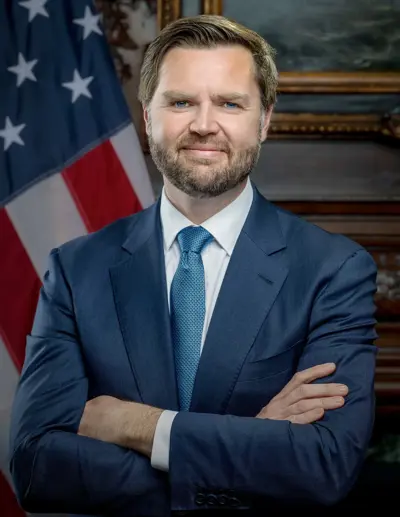
James David Vance (born James Donald Bowman; August 2, 1984) is an American politician, author, attorney, and Marine Corps veteran serving as the 50th vice president of the United States since 2025 under President Donald Trump. A member of the Republican Party, he represented Ohio in the U.S. Senate from 2023 to 2025. After high school, Vance joined the Marine Corps, where he served as a military journalist from 2003 to 2007, and was deployed to the Iraq War for six months in 2005. He graduated from Ohio State University with a bachelor's degree in 2009 and Yale Law School with a law degree in 2013. He practiced briefly as a corporate lawyer before embarking on a career in the tech industry as a venture capitalist. His memoir, Hillbilly Elegy, was published in 2016 and adapted into a film in 2020.
