Adam Smith Quotes
Every tax ought to be so contrived as both to take out and keep out of the pockets of the people as little as possible, over and above what it brings into the public treasury.
Adam Smith, 1723-1790, Scottish Political Economist, 4th Principle of Taxation
Sourced by: Eigen's Political and Historical Quotations


He turned out to be very wrong as there were a number of times in American history when there were tax rates in excess of 70 percent, and they were collected.

This is the most articulate historical statement of the modern conservative mantra regarding taxes. However, one change has taken place. The words “necessarily” and “often” tend to be left out of the more modern ideological statements. Mellon’s original statement has never really had any politicians or economists who disagreed. Politicians of all economic persuasions have generally accepted the Mellon statement but the extreme conservatives’ creed is that a lowering of taxes always produces more revenue and a tax increase will inevitably lead to greater tax revenue—a position which Mellon never took. Mellon however was very solicitous of the wealthy, felt the welfare of the nation depended on their prosperity, and was a strong advocate of what was later called ‘trickle down’ economics {628592}.

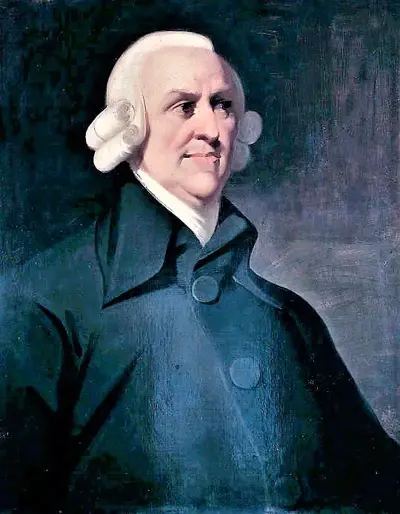
Adam Smith FRSA was a Scottish economist, philosopher as well as a moral philosopher, a pioneer of political economy, and a key figure during the Scottish Enlightenment, also known as ''The Father of Economics'' or ''The Father of Capitalism''. Smith wrote two classic works, The Theory of Moral Sentiments (1759) and An Inquiry into the Nature and Causes of the Wealth of Nations (1776). The latter, often abbreviated as The Wealth of Nations, is considered his magnum opus and the first modern work of economics. In his work, Adam Smith introduced his theory of absolute advantage.
