Seneca the Younger Quotes
Every man prefers belief to the exercise of judgment.
Seneca, Lucius Annaeus. Moral Essays, Volume II. Translated by John W. Basore, Harvard University Press, 1932, p. 99.


3rd Earl Russell of Kingston


He was persecuted by the Roman Catholic Church for figuring out that the earth revolved around the sun which was contrary to church teaching at the time.


He was too ill to read the speech himself and it was read by James Wilson for him.
This turns out to be very much a cultural phenomenon. Amongst educated Englishmen and many scientists and philosophers from America and other cultures but in some cultures opinions stated without passion are often not believed�this is particularly true in the Middle East but exists in many subcultures of America. In science, and the logical philosophy that Russell was so expert in, either you could prove something or you could not. If you could, the passion was unnecessary. If you could not, it was irrelevant. However, in most political issues, except those based on science, most assertions are not provable and although there may be some evidence for a view, it is not determinative. So volume. Bombast, and passion tries to persuade where logic cannot. Russell and many scientists and Philosophers distrust these statements, but the politician must deal with most of them, as public policy must be made whether the issue is scientifically demonstrable or not. Life and society must go on. However, when scientists testify before Congressional committees or in other political arenas, their lack of passion is taken by many as a lack of conviction or a lack of surety, while if they did speak with great passion, they would break the norms of the scientific community in which they work, for it is regarded as unethical to persuade people with anything but the evidence and logic.

The last sentence is the most frequent part of this quote. It is frequency prefaced with “Too often…” which is not part of the original quote.

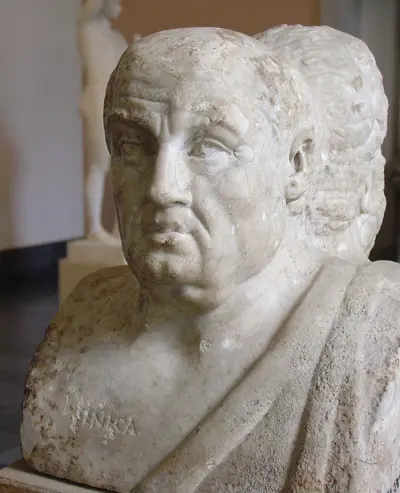
Lucius Annaeus Seneca the Younger (/ˈsɛnɪkə/; c. 4 BC – AD 65), usually known as Seneca, was a Roman Stoic philosopher, statesman, dramatist, and in one work, satirist from the Silver Age of Latin literature.
