Madeleine Albright Quotes
Crown Prince Abdullah and his successors must do more than simply condemn extremism and terror; they must rip them out by roots that have become deeply implanted in the kingdom’s sandy soil.
Madeleine Albright, U. S. Secretary of State (Democrat), U. S. Ambassador to the United Nations (Democrat), “Bridges, Bombs, or Bluster?” Foreign Affairs, September/October 2003
Sourced by: Eigen's Political and Historical Quotations


Islamic religious extremists do not allow freedom of religion, freedom of speech, freedom of the press, right to life, freedom from torture and mutilation, self-government, gender equality, protection of children or women from violence, sexual freedom, freedom of expression, reproductive rights for women, right work, which are just a few. The modern Islamic extremists allow about the same human rights as did the Christian Kings and the Church of 1000 years ago. Ironically, it is less respect for human rights that many of the great Islamic societies provided 1000 years ago.

Islamic extremists had killed thousands on Russian citizens and military men in Chechen, one of the states in Russia. At the time--before 9-11--Americans in the homeland had never been attacked by Islamic religious extremists as the Russians had. Some Americans were very critical of the Russians for using force and troops to deal with the terrorists and urged Putin to negotiate. This was Putin's reply. It was taken by many Americans as an unnecessarily hard line then. After 9-11, however, American views towards negotiations with terrorists generally resembled Putin in this quotation. Many Americans then developed much more sympathy with the Russian position on terrorism inside Russia.

Objecting to the United States supporting the Kurdish Peshmerga forces attacking ISIS in Syria when they were affiliated with the PKK an organization that used terror tactics to gain independence for Kurds in Turkey.


Language differences and code words of different cultures are not always understood by other cultures. In this case the Sheikh wanted to condemn terrorism which was the official position of the Saudi Arabian government. However, Saudi Arabia, because it contains Mecca the Islamic Holy City, has a preeminent place in the Muslim world has a position of leadership which no other Islamic country has. While people in the West applauded the statement, it had little or no impact in the Muslim world. The reason is that the Arabic word he used for terrorism was a heinous one—a word which Islamic Terrorists (and most other Muslims) believe does not refer to their activities. Terrorism culturally means only acts of violence which are not morally justified. Not only do most Muslim terrorists perceive that they are Morally justified, but most have been given various fatwas (religious legal rulings) that says that their acts are required by God. For example, in a perversity of logic, Hamas—the Palestinian terrorist organization—sees Israeli acts like assassinating the suicide bomb engineers as terrorism while their behavior is a legitimate, moral struggle for national liberation. Few Islamic religious leaders speak out against terrorism, and those who do are often not understood to apply to Islamic terrorists.


After years of minority Sunni Muslim rule of Iraq, the U. S. invasion gave the majority Shiite Muslims political control. The Sunnis and Shiites have been at each others throats for centuries despite the fact that they are both Muslims. Saudi Arabia is the center of Sunni Islam and many of its religious extremists issue edicts advocating the suicide bombing of Shiite mosques and other facilities and assuring martyrdom for the suicide bombers.


There can be a heavy cost in terms of giving up rights, costs of prevention the internal conflict in the society about how to deal with the terrorists.


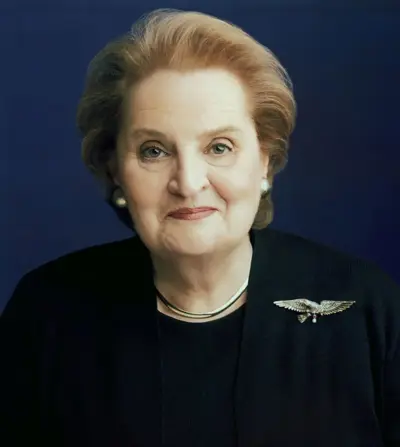
Madeleine Jana Korbel Albright is an American politician and diplomat who served as the first female United States Secretary of State in U.S. history from 1997 to 2001 under President Bill Clinton.
