Hassan Rouhani Quotes
Citizenship rights is about making all Iranians feel they are part of one nation, one identity, under one umbrella they can feel proud of.
Rouhani, Hassan. Speech on the Charter on Citizens' Rights. 19 Dec. 2016, Tehran, Iran.


Before the French Revolution, Jews could freely practice their own religion in France but they could not hold citizenship, become professionals, or a host of other privileges of citizenship. Clermont-Tonnerre and other liberals argued that Jews should be given citizenship. The Jacobins--conservative Catholics close to the Papacy--opposed granting citizenship to Jews or Protestants. One argument that the Jacobins gave was that each of these sects would be separate nations within France and not necessarily have French national interest as a priority. Clermont-Tonnerre gave this response which has been the French philosophy about minority citizenship since then. Their thought was that anyone may become a French citizen as an individual but he or she should do so because he/she wants to accept French values and support the French nation. This view worked quite will over the years until the large immigration of Muslims starting in the 1960s where many new immigrants just wanted to live in France and earn a living there, but did not want to identify with French national aspirations or adopt French culture or values. America, had no such demands and those immigrants who tended to identify primarily with their country or culture of origin and not assimilate were allowed to do so, but the American way of life was so attractive that many immigrants did adopt it and even if they did not, their children almost inevitably did. That has not happened in France.


At the time sectionalism was extensive in America. Most Iowa and Northern families still remembered a relative who had been “killed by the rebels” in the Civil War. The South still resented the rest of the country. The East and Midwest had much better educated than the rest of the country. Most important, there was very little contact between Americans of different sections. Until the great Eisenhower initiative of a National Highway System sectionalism was common. Presidents were constantly trying to develop a national American spirit.
What is particularly interesting about this quotation is that at the time, this was a common concern by political and social thinkers of the West. Here however, we learn that there was apparently the same concern and problem ongoing in the Muslim Middle East.


This mode of national definition is characteristic of many nations of Europe as well.


The Southern authorities were particularly angry with people form the North coming South to demonstrate over unconstitutional and immoral segregation laws. Northerners were considered as having no business with Southern desegregation. Mrs. Peabody, and the wives of a number of wives of Christian Bishops, black and white, went to a restaurant in St. Augustine and requested service which was contrary to the segregation laws of Florida at the time. The women were arrested. The act of civil disobedience in integrating the restaurant was one act of a planned desegregation strategy worked out with Martin Luther King’s SCLC organization. The mature age of the women and their prominent husbands brought a great deal of newspaper coverage which is just what the demonstrators wanted. The photo is of Mrs. Peabody getting arrested. See {637404} and {637406} for more on this incident.


The first Native American to become a General Officer. Appointed by President Grant in 1869. When Lee arrived there were many Black troops and he mistook General Parker for a Negro but then apologized saying that “I am glad to see one real American here.” This was Parker’s reply.


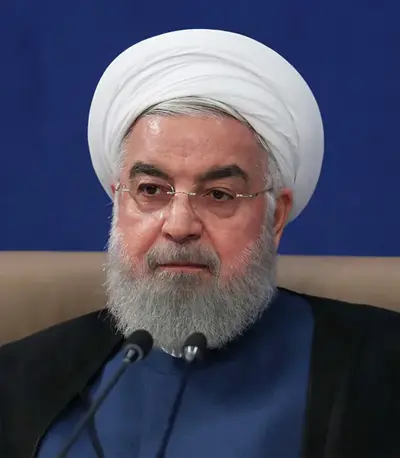
Hassan Rouhani is an Iranian politician serving as the seventh and current President of Iran since 3 August 2013. He was also a lawyer, academic, former diplomat and Islamic cleric. He has been a member of Iran's Assembly of Experts since 1999, member of the Expediency Council since 1991, and a member of the Supreme National Security Council since 1989. Rouhani was deputy speaker of the fourth and fifth terms of the Parliament of Iran (Majlis) and Secretary of the Supreme National Security Council from 1989 to 2005. In the latter capacity, he was the country's top negotiator with the EU three, UK, France, and Germany, on nuclear technology in Iran, and has also served as a Shia mujtahid (a senior cleric), and economic trade negotiator.:138 He has expressed official support for upholding the rights of ethnic and religious minorities. In 2013, he appointed former industries minister Eshaq Jahangiri as his first vice-president.
