Montesquieu Quotes
Christians are beginning to lose the spirit of intolerance which animated them: experience has shown the error of the expulsion of the Jews from Spain, and of the persecution of those Christians in France whose belief differed a little from that of the king. They have realized that zeal for the advancement of religion is different from a due attachment to it; and that in order to love it and fulfil its behests, it is not necessary to hate and persecute those who are opposed to it.
Montesquieu, Charles de Secondat. Persian Letters. Translated by John Davidson, George Routledge and Sons, 1891, p. 129.


Wesley had been to Island several times and was interested in affairs there. He was a strong advocate of freedom of religion but the violence of the earlier religious conflict made him very wary of the Irish Roman Catholics who seemed to him particularly prone to religious violence.

Toleration is a relative term. The Muslim Moors made Christians (and Jews) pay a special tax. At times they were forced to wear special clothing so that they could be readily identified. And they could not build churches larger or taller than the smallest mosque in the community. At times, their occupations were restricted but at other times Christians and Jews were appointed to the highest positions like Vizier. The Inquisition, in contrast, forced all Muslims (and Jews) to leave the country without any of their property or money or be tortured and killed—usually by burning at the stake unless of course that they converted to Christianity.

Henry of Navarre

This was the beginning of the inquisition.


Henry of Navarre. This edict made the Huguenots and other Protestants legal in France whereas only 26 years earlier 50,000 of them had been slaughtered in France by the Catholics. It wasn’t a century before the Catholics reneged. See {617765}.


At first this clause appears to be very enlightened and establishing freedom of conscience. This clause allowed Catholics to practice freely whereas in other colonies they could not. However, as one reads on, it becomes clear that the “tolerance” is limited to Christians only. Then if one examines the exception within the parentheses and refer to the rest of the act—see {611994}—, one finds that even Christians who have certain theological beliefs are to be put to death—those for example who deny the holiness of the Trinity such as Unitarians who were a major group in the New England Colonies. It was a significant step at the time however to protect Roman Catholics.


In one of the historical ironies of the 12th century, a Christian sect preferred the rule of the Muslims than their Christian brethren—on the grounds of religious tolerance. It illustrates the changes that take place over time. By the 21st century, it was the Christians who were thought of as tolerant and the Muslims as the opposite.
Historically, when Christian Europe was torturing and butchering people over differences of religious opinion, Islam was for the time, in most places, a model of tolerance. Suhrawardy died before Islam degenerated into an intolerance that almost rivaled in brutality that of the Christians centuries ago. And while his statement about the invention and initiation of brutal intolerance is correct, he would be shocked at the behavior of 21st century Iran, Pakistan and some other Islamic nations who from a traditional Islamic perspective had degenerated.

He is a Greek Orthodox Christian, and he correctly observes that the Islamic world was considerably more tolerant than the Christian until the 18th century when Islam had become less tolerant in the Middle East while the Christians were modernizing and going through a cultural and intellectual enlightenment and societal modernization while the Muslims, became less tolerant than they were in earlier years leading to the modern situation.

Samuel Langhorne Clemens, 1835-1910

Not all the relations between Irish Catholic and Protestants were hostile. There was a commonality in their Irish nationality and many protestants—especially the educated and more sophisticated—were opposed to the restrictions imposed by England on the rights of the Roman Catholic to practice their religion. See {639274} for another example.
The reform bill was developed by the then current Minister of Education who views were quite opposite to Corkey’s. One of the reforms was to eliminate the Bible Teaching and other religious instructions in the public schools. Then these other undesirables would enroll in the public schools whereas before, the Protestants were able to operate segregated public schools where very few Catholics would attend. The religious bigotry by the Catholics in the South of Ireland was equaled if not exceeded by that of the Protestants in Northern Ireland.
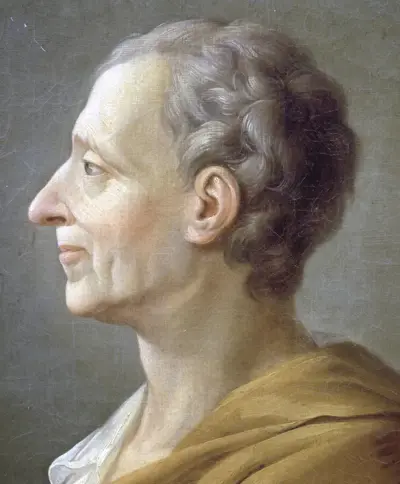
Charles-Louis de Secondat, Baron de La Brède et de Montesquieu, generally referred to as simply Montesquieu, was a French judge, man of letters, and political philosopher.
