Steve King Quotes
Christian abolitionists gave their lives by the hundreds of thousands to end slavery.
United States, Congress, House. Congressional Record, Government Printing Office, 18 June 2009, p. H6983.


Brown was executed for trying to steal federal arms and start a slave rebellion. However, to many Americans, his moral judgment was correct. He became a martyr for many abolitionists, and some Northern Civil War songs extolled him and saw his as an early forerunner of a great moral struggle. See Thoreau {633849} as an example. There were many other Americans who were abolitionists and did not approve of either of the method his violent raid or its purpose of arming the slaves as they feared a bloodbath of vengeance.

This was the first success that the anti-slavery forces of England had—the recognition and official classification of slaves as humans. After that, it was easier to abolish the slave trade which occurred 16 years thereafter.


We beseech His Majesty to interest himself in ameliorating the condition of negroes in the colonies.
This Cahier was the consensus of the Clergy of Blois in 1789. There were cahiers of several provinces of France—some by the clergy, some by the nobles. What is fascinating is the emergence of many of the pre-Revolutionary French concepts. The example of the American revolution and its principles was known throughout the educated classes of France.


Benezet was a Huguenot whose family had been persecuted in France. He identified with the cause of Blacks, Indians and Acadians. He was also one of the first leaders of the American Peace Movement.

Earlier {629154} Smith was much more sympathetic with slavery. His views evolved as you can see by the comparison. He stated that he had a vision and made two prophesies {629156} that indeed came true. The last idea of slave buyouts seemed plausible to many abolitionists initially when they were not really knowledgeable about the economics of slavery. However, once they studied it, it became clear what it would not work even if the Southerners would then be willing to accept Blacks as free laborers which most were not, The two biggest problems were: 1) the international slave trade had been abolished. The only source of new slaves for growth was breeding them. Therefore, having slaves had TWO economic values—the work that they could do and the reproduction of themselves. A critical mass of owned slaves produced an income forever. And for Southerners who were culturally adverse to work (see {629169}), just having cash for their slaves was not enough. They were the servants, the farm labor, and their recreational sex. 2) and most important, the value or the slaves of the South was greater than the economic value of all the land, all the farms, all the buildings, all the factories, and all the inventory of the stores of the South all put together. The Southern slaves were the majority of the wealth of the south. There was no asset that could ever produce enough value to pay for the slaves—even over time. It would be like trying to buy all the shares of all the corporations in America today. There is no asset big enough to raise the money to ever finance it. The idea may have worked in Colonial America or even prior to the outlaw of the international slave trade, but by the time anyone took the idea seriously it was economically no longer feasible.


Wilberforce was one of the early staunch opponents of slavery.

This is a particularly memorable quotation for several reasons. First the address was given by a young senior student who would later be a member of Congress, a effective abolitionist, and the author of various pieces of legislation that vexed the South. What is even more memorable is that the oration was given at an Ivy League College Official Graduation. The Ivy league schools, despite their reputation for intellectual freedom, generally were very adverse to any discussion about the slavery issue as it would cause too much passionate contention. See {621346} for an example at Harvard. In addition, Brown University was in Providence RI, where the economy depended in substantial part on slavery. The Co-Founder of Brown was himself a slave trader {622028}. This was one of the early American anti-slavery orations.


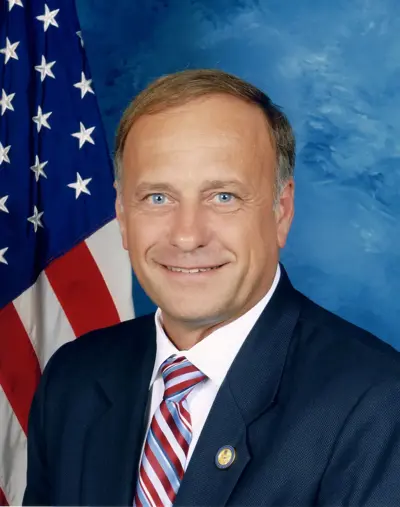
Steven Arnold King is an American politician and businessman who served as the U.S. Representative for Iowa's 4th congressional district from 2003 to 2021. A member of the Republican Party, he represented Iowa's 5th congressional district until redistricting.
