Mahatma Gandhi Quotes
Centralization as a system is inconsistent with a non-violent structure of society.
Gandhi, Mahatma. The Collected Works of Mahatma Gandhi. Vol. 75, Publications Division, Ministry of Information and Broadcasting, Government of India, 1979, p. 224.


“Father of American Anthropology”


It is hard for us today to understand why intelligent, thoughtful, people would seriously consider and even advocate anarchy. Yet there were many intelligent people who preached anarchy. The key to understanding this is that it is also hard for us to realize how terrible and actually dangerous was typical life under the Russian Government of the Czars. It was not only that most people were serfs--virtually slaves, but the government officials, the military and civilian both, could and did, abuse people in every way imaginable. In America today, if any of us were unfortunate to be the victim of violence, the odds are high that it would be at the hands of another citizen. In Russia (and other countries) at the time, the odds were that the perpetrator of the violence was a government official or government sanctioned person—police, military, aristocrats, civil officers. As but one example. Cossacks would frequently get drunk, pillage and rape a community and kill any who resisted—all with impunity. This quotation from Tolstoy is the classic argument of the anarchist at the time. It was impossible that the absence of government could be as bad as the government then was.

There had been a proposal to consolidate the secret service and the FBI into a single organization. What is fascinating, over and above her very sophisticated reasoning, is that fact that the First Lady not only takes a position but writes about it in her daily newspaper column, but she did this while the Congress and her husband the President were weighing the issue. This is another example of Mrs. Roosevelt’s unique role in American politics. To many feminists, they find the fact that the President could and would function with his wife making all these public, independent and uncoordinated judgment, almost unique in political history. He was an admirable role model of a relationship with a wife from a gender equality point of view.


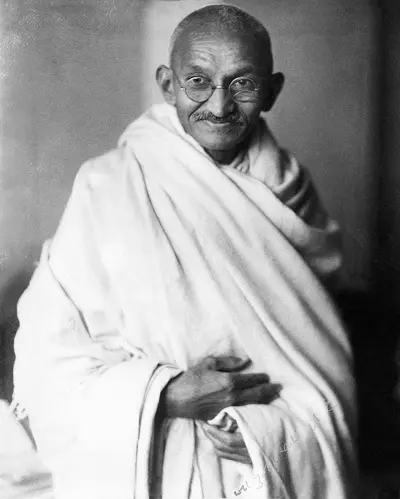
Mohandas Karamchand Gandhi was an Indian lawyer, anti-colonial nationalist, and political ethicist, who employed nonviolent resistance to lead the successful campaign for India's independence from British rule, and in turn inspired movements for civil rights and freedom across the world. The honorific Mahātmā (Sanskrit: "great-souled", "venerable"), first applied to him in 1914 in South Africa, is now used throughout the world.
