Anna Akhmatova Quotes
But our land will not be divided by the enemy at his pleasure the Mother-of-God will spread a white shroud over these great sorrows
Written at the onset of WW I
Anna Akhmatova, 1890-*, Russian Poet, The Prophesy of the One-Eyed Beggar, 1914
Sourced by: Eigen's Political and Historical Quotations


The American Indian protection assurances from demagogues and ghost dancers, had a parallel among the white Afrikaners. Many who believed him died from bullet wounds.


The Chinese were massacred when the Japanese invaded with atrocities against civilians that were inconceivable until Hitler began his in Europe. However, there were many Chinese we worked against the Japanese including the Communists who made a truce with Chiang (see {636322}) so that they could oust the Japanese invaders.

The Congress had applauded his message vigorously.

Note that even then, De Gaulle’s nationalist ego focused not only on glory but glory that need not be shared. It was always a great strength and a great weakness for him. He and many French officers were so fixed on the glory of beating the Germans, that they did not focus on their ½ million casualties and were not prepared for the German countermeasures that turned the battle from a French victory to a long standoff and stalemate of the “Western Front” where neither side could advance much. Note also that De Gaulle failed to mention the British Expeditionary Force that twice saved the French from being overrun. Denial for the honor of France was always one of De Gaulle’s characteristics. See {642233} for the English commander’s view of the outcome of the Battle of the Marne.


The only soldier ever so honored


So far as the Iraq government was concerned the important enemy were the minority Sunni Muslims who had dominated the Shiites before the American Invasion. For America the enemy was Al Qaeda and the terrorists as well as the Sunnis. We ended up fighting Sunnis and even Shiites as the definition of the enemy changed with time.

This quotation is important for two reasons. First, it shows that there was a very hostile environment in Europe well before the assassination of the Archduke of Austria that “triggered” WWI. Second, that the Germans were racist before Hitler ever came on the scene. The Emperor demagogued the issue and took it to new extremes, but the evil was there. To the Germans, the Slavs and Russians were a lesser form of humanity than the Germans. The Austrians were threatening to attack Serbia and Russia. The Austro-Hungarian Empire, ruled many ethnic Slavs, Russians and Muslims—the lower forms of humanity—and long before Hitler, Wilhelm and other leading Germans thought that the Germanic Peoples should rule that part of the world as the lesser “races” were not fit to rule.

The War Plan that the Germans had developed--{642092}—had gone awry at the battle of the Marne in late 1914.

German ally, the Austro-Hungarian Empire had declared war on Serbia. See {642085}. The Russian Czar was under great pressure because a large Roman Catholic Empire was warring against a small Orthodox co-religionist of Russia and Russians of all classes wanted Russia to defend Serbia. The Czar was making a good faith effort to stave off the war. What he did not realize was that Germany had actually planned for war against Russia and France and was using the alliance with Austria as an excuse.
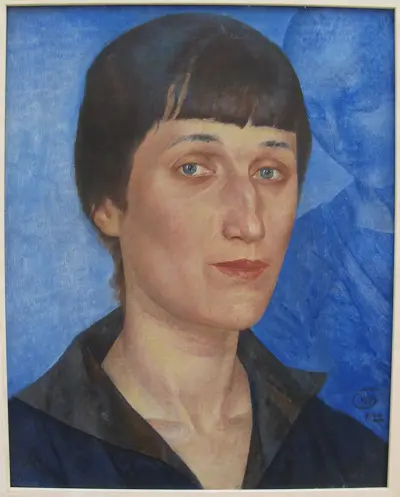
Anna Andreyevna Gorenko, better known by the pen name Anna Akhmatova, was one of the most significant Russian poets of the 20th century. She was shortlisted for the Nobel Prize in 1965 and received second-most (three) nominations for the award the following year.
